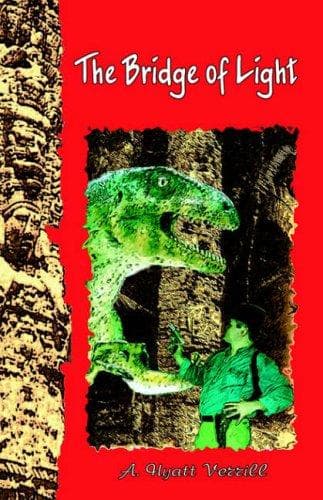
The bridge of lightVerrill, A. Hyatt (Alpheus Hyatt)
Science
The bridge of light
Verrill, A. Hyatt (Alpheus Hyatt)
Adventure stories; Central America -- Fiction; Mayas -- Fiction; Science fiction
These were facts known to every student of American archeology and were
inexplicable puzzles, mysteries as great as how the Mayas produced
their wonderful sculptured monuments, how they worked the hardest of
precious stones, how they accomplished many remarkable feats. But
here, in Mictolan, their strange paradoxical development had gone
beyond all bounds of imagination. They still used their ancient--their
immeasurably ancient--system of mathematics, the vigesimal system; they
still used the equally ancient calendrical system of the Tonalmatl or
religious calendar, the Calendar-Round the Initial Series dates, the
Long Count and the Cycles by which any date could be established within
a period of five million years, and they still used the glyph writing.
Had they possessed wheels, had they discovered the use of iron or
steel, had they even acquired a knowledge of machinery, of chemistry,
of electricity, I might not have been so greatly astonished. But
they had none of these, and yet they possessed an intimate knowledge
of matters undreamed of, unsuspected by any other race on earth, of
matters that seemed downright uncanny, supernatural and utterly beyond
belief.
CHAPTER X
The Gods Who Carved the Stones
I HAD already noticed the gigantic size of vegetable products, and I
had assumed that their size was partly, if not wholly, due to the fact
that there was no darkness in the valley. In this surmise I found I was
correct, but the light itself, which was the basic source of this light
that so puzzled me, was most astounding. In fact, its source was also
the source of everything amazing that I observed. It was radium, or at
least some intensely radioactive material, which apparently existed
in vast quantities in a certain section of the valley. How the people
had learned to make use of this marvelous force of nature of which
we know so little, I cannot say; but as will be seen, certain things
that I discovered led me to believe that it had been used, for certain
purposes, from the most ancient times by the Mayas--and possibly by
other prehistoric American races. This was my first epochal discovery,
and it explained many hitherto inexplicable matters. We had passed
through the city and had wandered across the fields beyond, when, in
gazing across the valley to the east, I noticed a barren, desolate
area. Calling the prince’s attention to it, I asked about it. To my
astonishment he replied that it was “the sacred place of the gods who
cut the stones.” I felt I was on the verge of a most interesting and
epochal discovery, so I started towards the spot despite the protests
of Azcopil, who seemed to have a superstitious terror of the place.
Itza, too, held back, evidently in fear, but neither could give a lucid
or intelligent reason for his dread. The gods, or spirits (the two are
synonymous in the Zutugil), were powerful, they brought illness and
death upon all who invaded their domain, and though they were those
Public-domain text, read in full here on John Shaqi.
Reviews
Reviews
No reviews yet
Be the first to share your thoughts on this work.
Elsewhere in the archive
Join the Discussion
Join the discussion
Sign in to leave a comment or review.
Sign InorCreate an account