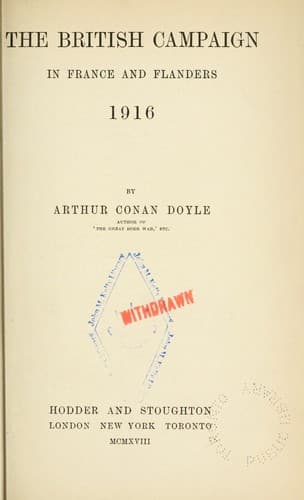
The British Campaign in France and Flanders, 1916Doyle, Arthur Conan
History
The British Campaign in France and Flanders, 1916
Doyle, Arthur Conan
World War, 1914-1918 -- Campaigns -- Western Front
Once again the left flank of the Australians was in close
co-operation with a British Division. The Forty-eighth had been
withdrawn and replaced by the Twelfth, a division which was rapidly
acquiring a very solid reputation in the army. The men of the 7th
Sussex upon the right and those of Surrey and of Kent upon the left
were in the front of the battle-line, which rolled slowly up the
slope of Pozières, continually driving the German resistance before
it. The ground gained early in August was some 2000 yards of
frontage with a depth of 400 yards, and though the whole ridge, and
the Windmill {195} which marks it, had not yet been cleared, the fact
that the British had a good foothold upon it was of the utmost
strategical importance, apart from the continual stream of prisoners
who fell into their hands. The Sussex battalion linked up with the
Australians, and nothing could have been closer than the co-operation
between the two, so much so that it is on record that with a glorious
recklessness a bunch of Australians pushed forward without orders in
order to keep the Sussex men company in one of their attacks. The
South Saxons have again and again shown that there is no more solid
military material in England. It is said that a rampant pig with "We
won't be druv!" as a motto was an old emblem of that ancient county.
Her sons assuredly lived up to the legend during the War.
On the morning of the 6th and of the 7th two counter-attacks stormed
up to the new British line. The first was small and easily repelled,
a sporadic effort by some gallant hot-headed officer, who died in the
venture, clicking his Mauser to the last. The second was serious,
for three battalions came very gallantly forwards, and a sudden rush
of 1500 Germans, some of whom carried _flammenwerfer_, burst into the
trenches at two separate points, making prisoners of some 50
Australians who were cut off from their comrades. The attack was
bravely delivered in broad daylight, the enemy coming on in good line
in the face of severe fire; but the Australians, with their usual
individuality, rallied, and not only repulsed the enemy, but captured
many of them, besides recapturing the prisoners whom they had taken.
This was the supreme German attempt to recapture the position, but
they were by no means able to {196} reconcile themselves to the loss
of it, and came on again and again in smaller assaults spread over
several days, which had no result save to increase their already very
heavy losses in this region.
Public-domain text, read in full here on John Shaqi.
Reviews
Reviews
No reviews yet
Be the first to share your thoughts on this work.
Elsewhere in the archive
Join the Discussion
Join the discussion
Sign in to leave a comment or review.
Sign InorCreate an account