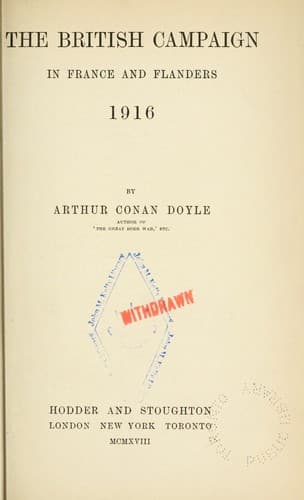
The British Campaign in France and Flanders, 1916Doyle, Arthur Conan
History
The British Campaign in France and Flanders, 1916
Doyle, Arthur Conan
World War, 1914-1918 -- Campaigns -- Western Front
On the signal for the general advance the Guards Division advanced on
the front between Delville Wood and Ginchy. The 1st Guards Brigade
was on the left, the 2nd on the right, and the 3rd in reserve. The
front line of battalions counting from the left were the 3rd, 2nd,
and 1st Coldstreams with the 3rd Grenadiers as right flank. Behind,
in the second line {253} from the left, were the 1st Irish, 2nd
Grenadiers, 2nd Irish, and 1st Scots. Disregarding the Quadrilateral
upon their right, which was holding up the Sixth Division, the Guards
swept magnificently onwards, losing many officers and men, but never
their direction or formation. From 6.20 in the morning until 4 P.M.
they overcame one obstacle after another, and continually advanced,
though the progress was unequal at different points on the line.
There was a short sharp bout of hand-to-hand fighting in the front
line trench, but the rush of the heavy disciplined Guardsmen was
irresistible, and the defenders were soon overwhelmed. In this mêlée
the battalions got badly mixed up, part of the 2nd Irish getting
carried away by the 1st Brigade. The 1st Brigade found a more
formidable obstacle in front of them in Vat Alley, but this also was
cleared after a struggle, the left-hand units getting mixed with the
right-hand units of the Fourteenth Division. About one o'clock the
3rd Coldstreams on the extreme left were held up by a wired strong
point. They were weak in numbers and almost without officers, so
they dug in as best they could and waited. On the right the 2nd
Brigade made good progress, and about mid-day its leading line topped
the low ridge and saw the land of promise beyond, the green slope
leading up to Lesboeufs, and in the middle of the slope, not more
than a thousand yards away, a battery of field-guns raining shrapnel
upon them. They could get no farther, and they consolidated at this
point, digging in under heavy shell-fire. The German infantry was
seen at one time marching down in artillery formation for a
counter-attack, but the movement was soon dispersed. In the evening
the front line, terribly worn and consisting {254} of a jumble of
exhausted men, held on firmly to the last inch that they had won.
Too weak to advance and too proud to retire, they lay under the
torment of the shells and waited for dusk. The colonel of the 3rd
Coldstreams, in temporary command of his brigade, had sent back
during the afternoon for help, and the 2nd Scots were sent up from
the 3rd Brigade, but the German barrage was so terrific that they
sustained very heavy losses, including Colonel Tempest, Wynne-Finch,
the adjutant, and many other officers. The battalion, or what
remained of it, arrived in time to help to crush a dangerous
counter-attack, which was sweeping down from between Guedecourt and
Lesboeufs, a repulse which was entirely inflicted by rifle and
Lewis-gun fire. A lieutenant seems to have been the senior officer
Public-domain text, read in full here on John Shaqi.
Reviews
Reviews
No reviews yet
Be the first to share your thoughts on this work.
Elsewhere in the archive
Join the Discussion
Join the discussion
Sign in to leave a comment or review.
Sign InorCreate an account