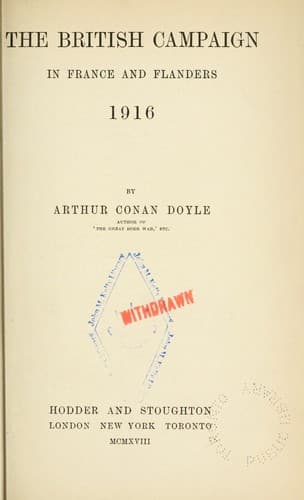
The British Campaign in France and Flanders, 1916Doyle, Arthur Conan
History
The British Campaign in France and Flanders, 1916
Doyle, Arthur Conan
World War, 1914-1918 -- Campaigns -- Western Front
The 111th Brigade from the Thirty-seventh Division was therefore sent
up, battalion by battalion, along the river-bank until it passed the
central obstacle and reached the Sunken Road. Thence the 13th Rifles
were sent forward with orders to reach the advanced line, where the
Hoods and Drakes, somewhat reduced in numbers but not in spirit, were
lying in front of Beaucourt. It was dark before these changes could
be made. The Riflemen, when they had attained their position, rested
their right upon the Ancre, and prolonged their left, clearing the
Germans out in that direction. This movement to the left was
strengthened in the early morning when the 13th Rifle Brigade and the
13th Royal Fusiliers of the same brigade came up to join in, whilst
the H.A.C. also advanced and took up a position on the right of the
naval men.
About seven o'clock the assault upon the village was ordered, under
the direction and leadership of Commander Freyberg of the Hoods,
already twice wounded, and wounded once again before his task was
finished. Sailors and Riflemen rushed forward at the signal, and
dashed with fierce impetuosity over the German line and down the
streets of the hamlet. The Honourable Artillery Company upon the
right {320} joined in the charge. It was completely successful, the
houses were rapidly cleared, the dug-outs taken, and many hundreds of
prisoners secured. The Riflemen emerging on the farther side of the
village immediately dug in under the direction of their only
remaining company officer. A footbridge was at the same time thrown
across the Ancre, so as to connect up with the Thirty-ninth Division
on the south.
The German redoubt had held out manfully until its line of retreat
was entirely cut off, and even then showed signs of continued
resistance. The tanks had already won such a position in the army
that they had become one of the last resources of the commander who
was in difficulties. During the night of November 13 three of these
engines were sent for to help in reducing the intractable German
centre. Their performance was typical both of their weakness and of
their value in this early stage of their evolution. One was hit and
disabled before ever it crossed the lines. A second stuck in the mud
and refused to budge. The third won its way over the German front
line and so terrorised the obstinate garrison that they were finally
induced to lay down their arms. Eight hundred prisoners came from
this one pocket, and the whole capture of the Naval Division amounted
to nearly 2000 men.
Public-domain text, read in full here on John Shaqi.
Reviews
Reviews
No reviews yet
Be the first to share your thoughts on this work.
Elsewhere in the archive
Join the Discussion
Join the discussion
Sign in to leave a comment or review.
Sign InorCreate an account