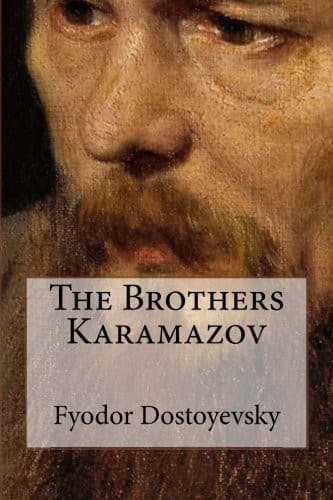
Brothers -- Fiction; Didactic fiction; Fathers and sons -- Fiction; Russia -- Social life and customs -- 1533-1917 -- Fiction
“Well, my lad, I’ve never met any one like you,” Fyodor Pavlovitch said
shortly, and gave him ten roubles. We may add that he not only believed
in his honesty, but had, for some reason, a liking for him, although
the young man looked as morosely at him as at every one and was always
silent. He rarely spoke. If it had occurred to any one to wonder at the
time what the young man was interested in, and what was in his mind, it
would have been impossible to tell by looking at him. Yet he used
sometimes to stop suddenly in the house, or even in the yard or street,
and would stand still for ten minutes, lost in thought. A physiognomist
studying his face would have said that there was no thought in it, no
reflection, but only a sort of contemplation. There is a remarkable
picture by the painter Kramskoy, called “Contemplation.” There is a
forest in winter, and on a roadway through the forest, in absolute
solitude, stands a peasant in a torn kaftan and bark shoes. He stands,
as it were, lost in thought. Yet he is not thinking; he is
“contemplating.” If any one touched him he would start and look at one
as though awakening and bewildered. It’s true he would come to himself
immediately; but if he were asked what he had been thinking about, he
would remember nothing. Yet probably he has, hidden within himself, the
impression which had dominated him during the period of contemplation.
Those impressions are dear to him and no doubt he hoards them
imperceptibly, and even unconsciously. How and why, of course, he does
not know either. He may suddenly, after hoarding impressions for many
years, abandon everything and go off to Jerusalem on a pilgrimage for
his soul’s salvation, or perhaps he will suddenly set fire to his
native village, and perhaps do both. There are a good many
“contemplatives” among the peasantry. Well, Smerdyakov was probably one
of them, and he probably was greedily hoarding up his impressions,
hardly knowing why.
Chapter VII.
The Controversy
But Balaam’s ass had suddenly spoken. The subject was a strange one.
Grigory had gone in the morning to make purchases, and had heard from
the shopkeeper Lukyanov the story of a Russian soldier which had
appeared in the newspaper of that day. This soldier had been taken
prisoner in some remote part of Asia, and was threatened with an
immediate agonizing death if he did not renounce Christianity and
follow Islam. He refused to deny his faith, and was tortured, flayed
alive, and died, praising and glorifying Christ. Grigory had related
the story at table. Fyodor Pavlovitch always liked, over the dessert
after dinner, to laugh and talk, if only with Grigory. This afternoon
he was in a particularly good-humored and expansive mood. Sipping his
brandy and listening to the story, he observed that they ought to make
a saint of a soldier like that, and to take his skin to some monastery.
“That would make the people flock, and bring the money in.”
Public-domain text, read in full here on John Shaqi.
Reviews
Reviews
No reviews yet
Be the first to share your thoughts on this work.
Elsewhere in the archive
Join the Discussion
Join the discussion
Sign in to leave a comment or review.
Sign InorCreate an account