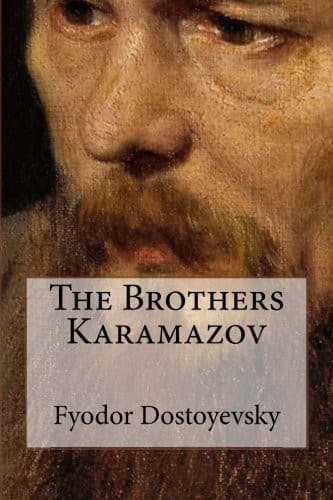
Brothers -- Fiction; Didactic fiction; Fathers and sons -- Fiction; Russia -- Social life and customs -- 1533-1917 -- Fiction
“Not a bit of it! He claims it as a merit for himself and his Church
that at last they have vanquished freedom and have done so to make men
happy. ‘For now’ (he is speaking of the Inquisition, of course) ‘for
the first time it has become possible to think of the happiness of men.
Man was created a rebel; and how can rebels be happy? Thou wast
warned,’ he says to Him. ‘Thou hast had no lack of admonitions and
warnings, but Thou didst not listen to those warnings; Thou didst
reject the only way by which men might be made happy. But, fortunately,
departing Thou didst hand on the work to us. Thou hast promised, Thou
hast established by Thy word, Thou hast given to us the right to bind
and to unbind, and now, of course, Thou canst not think of taking it
away. Why, then, hast Thou come to hinder us?’”
“And what’s the meaning of ‘no lack of admonitions and warnings’?”
asked Alyosha.
“Why, that’s the chief part of what the old man must say.
“‘The wise and dread spirit, the spirit of self-destruction and non-
existence,’ the old man goes on, ‘the great spirit talked with Thee in
the wilderness, and we are told in the books that he “tempted” Thee. Is
that so? And could anything truer be said than what he revealed to Thee
in three questions and what Thou didst reject, and what in the books is
called “the temptation”? And yet if there has ever been on earth a real
stupendous miracle, it took place on that day, on the day of the three
temptations. The statement of those three questions was itself the
miracle. If it were possible to imagine simply for the sake of argument
that those three questions of the dread spirit had perished utterly
from the books, and that we had to restore them and to invent them
anew, and to do so had gathered together all the wise men of the
earth—rulers, chief priests, learned men, philosophers, poets—and had
set them the task to invent three questions, such as would not only fit
the occasion, but express in three words, three human phrases, the
whole future history of the world and of humanity—dost Thou believe
that all the wisdom of the earth united could have invented anything in
depth and force equal to the three questions which were actually put to
Thee then by the wise and mighty spirit in the wilderness? From those
questions alone, from the miracle of their statement, we can see that
we have here to do not with the fleeting human intelligence, but with
the absolute and eternal. For in those three questions the whole
subsequent history of mankind is, as it were, brought together into one
whole, and foretold, and in them are united all the unsolved historical
contradictions of human nature. At the time it could not be so clear,
since the future was unknown; but now that fifteen hundred years have
passed, we see that everything in those three questions was so justly
divined and foretold, and has been so truly fulfilled, that nothing can
be added to them or taken from them.
Public-domain text, read in full here on John Shaqi.
Reviews
Reviews
No reviews yet
Be the first to share your thoughts on this work.
Elsewhere in the archive
Join the Discussion
Join the discussion
Sign in to leave a comment or review.
Sign InorCreate an account