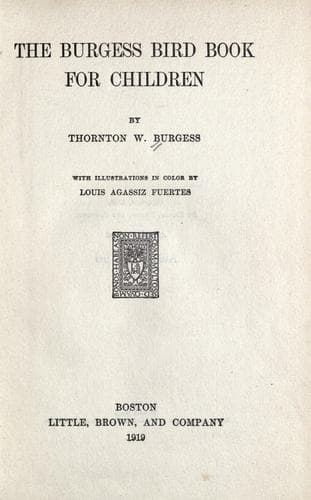
The Burgess Bird Book for ChildrenBurgess, Thornton W. (Thornton Waldo)
General
The Burgess Bird Book for Children
Burgess, Thornton W. (Thornton Waldo)
Birds -- Juvenile literature
“There isn't a word of truth in it,” declared Kitty emphatically. “She
builds a nest, such as it is, which isn't much, and she looks after her
own children. The Cuckoos have been given a bad name because of some
good-for-nothing cousins of theirs who live across the ocean where Bully
the English Sparrow belongs, and who, if all reports are true, really
are no better than Sally Sly the Cowbird. It's funny how a bad name
sticks. The Cuckoos have been accused of stealing the eggs of us other
birds, but I've never known them to do it and I've lived neighbor to
them for a long time, I guess they get their bad name because of their
habit of slipping about silently and keeping out of sight as much as
possible, as if they were guilty of doing something wrong and trying to
keep from being seen. As a matter of fact, they are mighty useful birds.
Farmer Brown ought to be tickled to death that Mr. and Mrs. Cuckoo have
come back to the Old Orchard this year.”
“Why?” demanded Peter.
“Do you see that cobwebby nest with all those hairy caterpillars on it
and around it up in that tree?” asked Kitty.
Peter replied that he did and that he had seen a great many nests just
like it, and had noticed how the caterpillars ate all the leaves near
them.
“I'll venture to say that you won't see very many leaves eaten around
that nest,” replied Kitty. “Those are called tent-caterpillars, and they
do an awful lot of damage. I can't bear them myself because they are so
hairy, and very few birds will touch them. But Cuckoo likes them. There
he comes now; just watch him.”
A long, slim Dove-like looking bird alighted close to the caterpillar's
nest. Above he was brownish-gray with just a little greenish tinge.
Beneath he was white. His wings were reddish-brown. His tail was a
little longer than that of Mourner the Dove. The outer feathers were
black tipped with white, while the middle feathers were the color of
his back. The upper half of his bill was black, but the under half was
yellow, and from this he is called the Yellow-billed Cuckoo. He has a
cousin very much like himself in appearance, save that his bill is all
black and he is listed the Black-billed Cuckoo.
Cuckoo made no sound but began to pick off the hairy caterpillars and
swallow them. When he had eaten all those in sight he made holes in the
silken web of the nest and picked out the caterpillars that were inside.
Finally, having eaten his fill, he flew off as silently as he had come
and disappeared among the bushes farther along the old stone wall. A
moment later they heard his voice, “Kow-kow-how-kow-kow-kow-kow-kow!”
“I suppose some folks would think that it is going to rain,” remarked
Kitty the Catbird. “They have the silly notion that Cuckoo only calls
just before rain, and so they call him the Rain Crow. But that isn't
so at all. Well, Peter, I guess I've gossiped enough for one morning. I
must go see how Mrs. Catbird is getting along.”
Public-domain text, read in full here on John Shaqi.
Reviews
Reviews
No reviews yet
Be the first to share your thoughts on this work.
Elsewhere in the archive
Join the Discussion
Join the discussion
Sign in to leave a comment or review.
Sign InorCreate an account