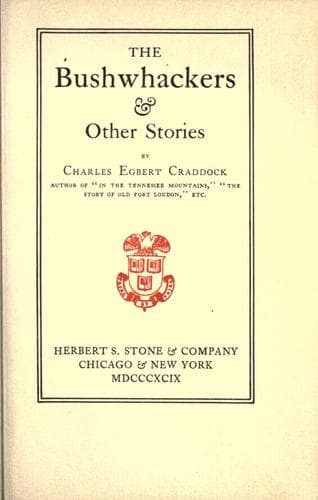
The bushwhackers & other storiesCraddock, Charles Egbert
General
The bushwhackers & other stories
Craddock, Charles Egbert
Mountain life -- Fiction; Tennessee -- Social life and customs -- Fiction
Mark was aware that they had taken his warning, although with no
appreciation of his motive in giving it. He could imagine the
contemptuous anger against him with which they looked significantly at
one another as they sat in the dusky shadows around the still, and he
knew that his sudden outburst into song must seem to them bravado--an
intimation that he did not care for having been summarily ejected
from the still-house, when in reality, only the recollection of it
sent the color flaming to his cheeks and the tears to his eyes. This
was not for the mere matter of pride, either; but for disappointment,
for fled illusions, for the realization that he had placed a false
valuation on these men. He had been flattered that they had cared for
his friendship, and reciprocally had valued him more than others;
they had relished and invited his companionship; they had treated him
almost as one of themselves. And although he saw much gambling and
drinking, sometimes resulting in brawls and furious fights, against
which his moral sense revolted, he felt sure that their dissipation was
transitory; they would all straighten out and settle down--when they
themselves were older. In truth, he could hardly have conceived that
this manifestation of to-night was the true identity of the friends to
whom he had attached himself--that their souls, their hearts, their
minds, were of a piece with the texture of their daily lives, as sooner
or later the event would show. In the disuse of good impulses and
honest qualities they grow lax and weak. They are the moral muscles of
the spiritual being, and, like the muscles of the physical body, they
must needs be exercised and trained to serve the best interests of the
soul.
“Yo-he! Yo-ho!” sang poor Mark, as he plunged into the forest, keeping
in the wood trail, called courteously a road, partly by the memory of
his horse, and partly by the keen sight of his gray eyes. He lapsed
presently into silence, for he had no heart for singing, and he
jogged on dispirited, gloomy, reflective, through the rugged ways of
the wilderness. It was fully two hours before he emerged into the more
open country about his mother’s house; as he reached the bank of the
stream he glanced up, toward the bridge--the faintest suggestion of two
parallel lines across the instarred sky. A great light flashed through
the heavens, followed by a comet-like sweep of fiery sparks.
“That thar air the ’leven o’clock train, I reckon,” said Mark, making
his cautious way among the bowlders and fragments of fallen rock to
the door of the house. The horse plucked up spirit to neigh gleefully
at the sight of his shanty and the thought of his supper. The sound
brought Mrs. Yates to the window of the cabin.
“Air that ye a-comin’, Mark?” she asked.
“It air me an’ Cockleburr,” replied her son, with an effort to be
cheerful too, and to cast away gloomy thoughts in the relief of being
once more at home.
“Air ye ez drunk ez or’nary?” demanded his mother.
Public-domain text, read in full here on John Shaqi.
Reviews
Reviews
No reviews yet
Be the first to share your thoughts on this work.
Join the Discussion
Join the discussion
Sign in to leave a comment or review.
Sign InorCreate an account