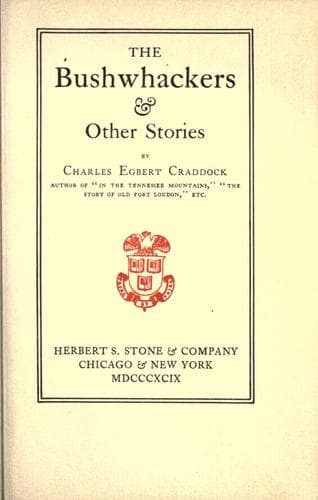
The bushwhackers & other storiesCraddock, Charles Egbert
General
The bushwhackers & other stories
Craddock, Charles Egbert
Mountain life -- Fiction; Tennessee -- Social life and customs -- Fiction
This was a damper. “I ain’t drunk nohow in the worl’,” said Mark,
sullenly.
“Whyn’t ye stay ter the still, then, till ye war soaked?” she gibed at
him.
Mark dismounted in silence; there was no saddle to be unbuckled, and
Cockleburr walked at once into the little shed to munch upon a handful
of hay and to dream of corn.
His master, entering the house, was saluted by the inquiry, “War
Painter Brice ez drunk ez common?”
“No, he warn’t drunk nuther.”
“Hev the still gone dry?” asked Mrs. Yates, affecting an air of deep
interest.
“Not ez I knows on, it hain’t,” said Mark.
“Thar must be suthin’ mighty comical a-goin on ef ye nor Painter nare
one air drunk. Is Aaron drunk, then? Nor Pete? nor Joe? Waal, this air
powerful disapp’intin’.” And she took off her spectacles, wiped them on
her apron, and shook her head slowly to and fro in solemn mockery.
“Waal,” she continued, with a more natural appearance of interest,
“what war they all a-talkin’ ’bout ter-night?”
Mark sat down, and looked gloomily at the dying embers in the deep
chimney-place for a moment, then he replied, evasively, “Nuthin’ much.”
“That’s what ye always say! Ef I go from hyar ter the spring yander,
I kin come back with more to tell than yer kin gether up in a day an’
a night at the still. It ’pears like ter me men war mos’ly made jes’
ter eat an’ drink, an’ thar tongues war gin ’em for no use but jes’ ter
keep ’em from feelin’ lonesome like.”
Mark did not respond to this sarcasm. His mother presently knelt
down on the rough stones of the hearth, and began to rake the coals
together, covering them with ashes, preliminary to retiring for the
night. She glanced up into his face as she completed the work; then,
with a gleam of fun in her eyes, she said:
“Ye look like ye’re studyin’ powerful hard, Mark. Mebbe ye air
a-cornsiderin’ ’bout gittin’ married. It’s ’bout time ez ye war
a-gittin’ another woman hyar ter work fur ye, ’kase I’m toler’ble old,
an’ can’t live forever mo’, an’ some day ye’ll find yerself desolated.”
“I ain’t a-studyin’ no more ’bout a-gettin’ married nor ye air
yerself,” Mark retorted, petulantly.
“Ye ain’t a-studyin’ much ’bout it, then,” said his mother. “The Bible
looks like it air a-pityin’ of widders mightily, but it ’pears ter me
that the worst of thar troubles is over.”
Then ensued a long silence. “Thar’s one thing to be sartain,” said
Mark, suddenly. “I ain’t never a-goin ter that thar still no more.”
“I hev hearn ye say that afore,” remarked Mrs. Yates, dryly. “An’ thar
never come a day when yer father war alive ez he didn’t say that very
word--nor a day as that word warn’t bruken.”
Public-domain text, read in full here on John Shaqi.
Reviews
Reviews
No reviews yet
Be the first to share your thoughts on this work.
Join the Discussion
Join the discussion
Sign in to leave a comment or review.
Sign InorCreate an account