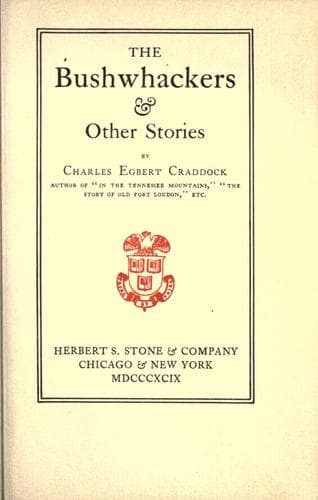
The bushwhackers & other storiesCraddock, Charles Egbert
General
The bushwhackers & other stories
Craddock, Charles Egbert
Mountain life -- Fiction; Tennessee -- Social life and customs -- Fiction
A faint streak of dawn was athwart the eastern clouds, and as the young
fellow turned his bewildered eyes upward to it the blood stood still in
his veins. Upon one of the parallel lines of the bridge was the figure
of man, belittled by the distance, and indistinctly defined against
the mottling sky; but the far-seeing gray eyes detected in a certain
untrammeled ease, as it moved lightly from one of the ties to another,
the Panther’s free motion.
Mark Yates hesitated. He cherished an almost superstitious reverence
for the church which Panther Brice had desecrated and destroyed, and he
feared the consequences of refusing to give the information demanded of
him. A denial of the knowledge he did not for a moment contemplate. And
struggling in his mind against these considerations was a recollection
of the hospitality of the Brices, and of the ill-starred friendship
that had taken root and grown and flourished at the still.
This hesitation was observed; there were significant looks interchanged
among the men, and the question was repeated, “Whar’s Painter Brice?”
The decision of the problems that agitated the mind of Mark Yates
was not left to him. He saw the figure on the bridge suddenly turn,
then start eagerly forward. A heavy freight train, almost noiseless
in the wild whirl of the wind, had approached very near without being
perceived by Panther Brice. He could not retrace his way before it
would be upon him--to cross the bridge in advance of it was his only
hope. He was dizzy from the loss of blood and the great height, and the
wind was blowing between the cliffs in a strong, unobstructed current.
As he ran rapidly onward, the first faint gleam of the approaching
headlight touched the bridge--a furious warning shriek of the whistle
mingled with a wild human cry, and the Panther, missing his footing,
fell like a thunderbolt into the depths of the black waters below.
There was a revulsion of feeling, very characteristic of inconstant
humanity, in the little group on the slope below the crag. Before
Mark Yates’s frantic exclamation, “Thar goes Painter Brice, an’ he’ll
be drownded sure!” had fairly died upon the air, half a dozen men were
struggling in the dark, cold water of the swift stream in the vain
attempt to rescue their hunted foe. Long after they had given up the
forlorn hope of saving his life, the morning sun for hours watched them
patrolling the banks for the recovery of the body.
“Ef we could haul that pore critter out somehow ’nother,” said Moses
Carter, his arm still dripping from the sharp strokes of the Panther’s
knife, “an’ git the preacher ter bury him somewhar under the pines like
he war a Christian, I could rest more sati’fied in my mind.”
The mountain stream never gave him up.
Public-domain text, read in full here on John Shaqi.
Reviews
Reviews
No reviews yet
Be the first to share your thoughts on this work.
Elsewhere in the archive
Join the Discussion
Join the discussion
Sign in to leave a comment or review.
Sign InorCreate an account