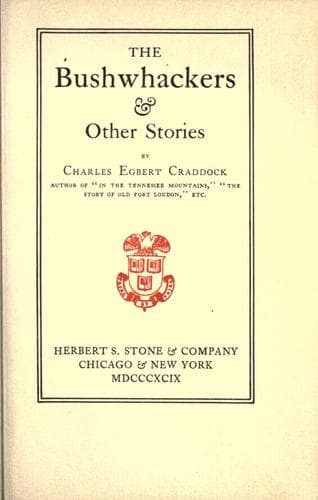
The bushwhackers & other storiesCraddock, Charles Egbert
General
The bushwhackers & other stories
Craddock, Charles Egbert
Mountain life -- Fiction; Tennessee -- Social life and customs -- Fiction
This event had a radical influence upon the future of Mark Yates.
Never again did he belittle the possible impetus given the moral
nature by those more trifling wrongs that always result in an
increased momentum toward crime. He was the first to discover more
of what Painter Brice had really intended,--had attempted,--than was
immediately apparent to the countryside in general. A fragment of the
door lay unburned among the charred remains of the little church in the
wilderness--a fragment that carried the lock, the key. Mark’s sharp
eyes fixed upon a salient point as he stood among the group that had
congregated there in the sad light of the awakening day. The key was
on the outside of the door, and it had been turned! The Panther had
doubtless been actuated by revenge, and perhaps, had been influenced
by the fear that information of the illicit distilling would be given
by the parson to the revenue authorities, as a means of breaking up an
element so inimical to the true progress of religion on the ridge--its
denizens hitherto availing themselves of the convenience of the still
to assuage any pricks of conscience they may have had in the matter,
and also fearing the swift and terrible fate that inevitably overtook
the informer. At all events, it was evident, that having reason to
believe the minister was still within, Painter Brice had noiselessly
locked the door that his unsuspecting enemy might also perish in the
flames. For in the primitive fashioning of the building there was no
aperture for light and air except the door--no window, save a small,
glassless square above the pulpit which, in the good time coming, the
congregation had hoped to glaze, to receive therefrom more light on
salvation. It was so small, so high, that perhaps no other man could
have slipped through it, save indeed the slim little “skimpy saint,”
and it was thus that he had escaped.
No vengeance followed the Panther’s brothers. “They hed ter do jes’
what Painter tole ’em, ye see,” was the explanation of this leniency.
And Mark Yates was always afterward described as “a peart smart boy,
ef he hedn’t holped the Brices ter fire the church-house.” The still
continued to be run according to the old regulations, except there
was no whisky sold to the church brethren. “That bein’ the word ez
John left behind him,” said Aaron. The laws of few departed rulers are
observed with the rigor which the Brices accorded to the Panther’s
word. The locality came to be generally avoided, and no one cared to
linger there after dark, save the three Brices, who sat as of old, in
the black shadows about the still.
Public-domain text, read in full here on John Shaqi.
Reviews
Reviews
No reviews yet
Be the first to share your thoughts on this work.
Elsewhere in the archive
Join the Discussion
Join the discussion
Sign in to leave a comment or review.
Sign InorCreate an account