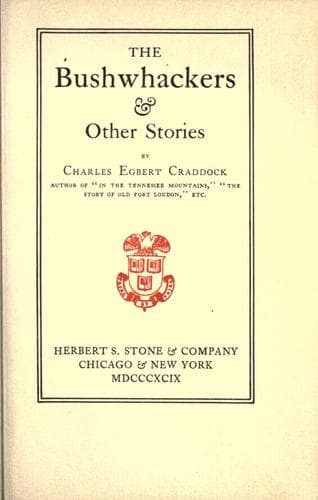
The bushwhackers & other storiesCraddock, Charles Egbert
General
The bushwhackers & other stories
Craddock, Charles Egbert
Mountain life -- Fiction; Tennessee -- Social life and customs -- Fiction
Presently as he went down a sunset glade, MacDonnell saw advancing
a notable figure, a Chickasaw chief, tall, lithe, active, muscular,
with a gait of athletic grace. He was wearing the warrior’s “crown,”
a towering head-dress in the form of a circlet of white swan’s
feathers of graduated height, standing fifteen inches high in front,
and at the bottom woven into a band of swan’s down--all so deftly
constructed that the method of the manufacture of the whole could not
be discerned, it is said, without taking it into the hand. To the
fringed borders of a sort of sleeveless hunting shirt of otter-skin
and his buckskin leggings bits of shells were attached and glittered,
and this betokened his wealth, for these beads represented the money
of the Indians, with the unique advantage that when not in active
circulation, one’s currency could be worn as an ornament. It has been
generally known under the generic name “wampum,” although several of
the Southern tribes called it “roanoke” or “pe-ack.” It was made in
tiny, tubular beads, of about an inch in length, of the conch and
mussel-shells, requiring the illimitable leisure of the Indian to
polish the cylinder to the desired glister, and drill through it the
hollow no larger than a knitting-needle might fill. His chest and arms
were painted symbolically in red and blue arabesques, and his face, of
a proud, alert cast was smeared with vermilion and white. All his flesh
glistened and shone with the polishing of some unguent. MacDonnell
had heard a deal of preaching in his time of the Scotch Presbyterian
persuasion, and in the dearth of expression Biblical phrases sometimes
came to him. “Oil to give him a cheerful countenance,” he quoted, still
gazing at the grim face and figure. So intently he gazed, indeed, that
the Indian hesitated, doubting if the Highland officer recognized
him as a friend. Breaking off a branch of a green locust hard by and
holding it aloft at one side, after the manner of a peaceful embassy,
he continued his stately advance until within a yard of the silent
Scotchman, also advancing. Then they both paused.
“_Ish la chu; Angona?_” said the Indian, in a sonorous voice. (Are you
come, a friend?)
With the true Briton’s aversion to palaver, intensified by his own
incapacity for its practice, Ronald MacDonnell discovered little
affinity for barbaric ceremonial. Nevertheless he was constrained
by the punctilious sense that a gentleman must reply to a courteous
greeting in the manner expected of him. His experience with the
Chickasaws had acquainted him with the appropriate response.
“_Arabre--O, Angona_,” (I am come, a friend) he returned, a trifle
sheepishly, and without the _ore rotunda_ effect of the elocution of
the Indian.
The young chief looked hard at him, evidently desirous of engaging him
in conversation, unaware that it was a game at which the Scotchman was
incapacitated for playing.
“Big battle,” he observed, after a doubtful interval.
Public-domain text, read in full here on John Shaqi.
Reviews
Reviews
No reviews yet
Be the first to share your thoughts on this work.
Elsewhere in the archive
Join the Discussion
Join the discussion
Sign in to leave a comment or review.
Sign InorCreate an account