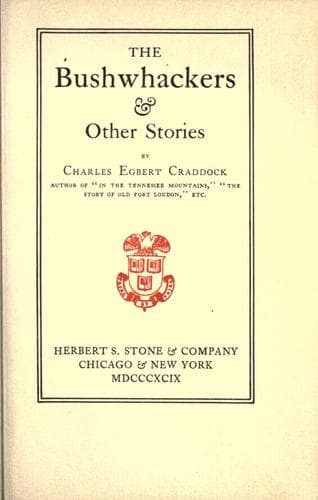
The bushwhackers & other storiesCraddock, Charles Egbert
General
The bushwhackers & other stories
Craddock, Charles Egbert
Mountain life -- Fiction; Tennessee -- Social life and customs -- Fiction
Ronald MacDonnell gave full credit to the strategy of Choolah. For
it would now seem--it needs must--that their little party no longer
feared the enemies in the quiet woods! They must have presumed the
Cherokees all gone! The Chickasaws were building a fire since the moon
was sinking. Probably they felt they could not lie down to sleep
without its protection and wolves very near in the woods. Listen to
that shrill, blood-curdling cry! They were surely disposing themselves
to rest! Already as the blaze began to leap up and show in the water
of the river below like a great red jewel, with the deep crystalline
lusters of a many-faceted ruby, figures might be seen by the flare of
the mounting flames, recumbent on the ground, wrapped in blankets; here
and there was tartan, an end of the plaid thrown over the face as the
Highlanders always slept; here and there a hunting-shirt and leggings
were plainly visible--all lying like the spokes of a wheel around the
central point of the fire.
“It is only the Muscogees who sleep in line,” Choolah explained to
MacDonnell, who had criticised the disposition.
The crafty Cherokees, stealthily approaching ever nearer and nearer,
had not seen in the first feeble glimmers of the flames the figures of
the seven men crawling gingerly back to the grotto in the covert of
the laurel, leaving around the fire merely billets of wood arrayed in
the blankets and stolen gear which the Owl had brought off from the
battle-field.
“But I am always in the wrong,” plained Oop-pa, sarcastically. “What
would you and the big tartan-man have to dress those warriors in if I
had not stayed for my goods?”
MacDonnell had urged his scruples. This was hardly according to the
rules of war. “But if the Cherokees fire on sleeping men,” he argued--
“_Angona_,” the wily Chickasaw assured him, suavely, “they are
disarmed. We can rush out and overpower them before they can load.”
“They ought to be able to fire three times to the minute,” thought
MacDonnell, who was a good drill.
But the Cherokees were not held to the rigorous manual of arms, and did
not attain to that degree of dexterity considered excellent efficiency
in that day although a breech-loading musket invented by Colonel
Patrick Ferguson, who met his death at King’s Mountain, was capable of
being fired seven times a minute, and was used not many years after
these events, with destructive effect, by his own command at the battle
of the Brandywine, in 1777.
Public-domain text, read in full here on John Shaqi.
Reviews
Reviews
No reviews yet
Be the first to share your thoughts on this work.
Elsewhere in the archive
Join the Discussion
Join the discussion
Sign in to leave a comment or review.
Sign InorCreate an account