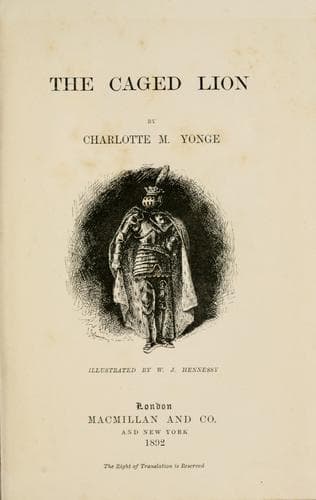
The Caged LionYonge, Charlotte M. (Charlotte Mary)
History
The Caged Lion
Yonge, Charlotte M. (Charlotte Mary)
James I, King of Scotland, 1394-1437 -- Fiction; Scotland -- History -- James I, 1406-1437 -- Fiction
By and by, a moment's lull of the universal din enabled Malcolm to hear
the Regent saying, 'Verily, there is a look of gentle nurture about the
lad. Look you, James, when the tables are drawn, you shall hold a
disputation with him. It will be sport to hear how you chop logic at
your Universities yonder.'
Malcolm's spirit sank. Such disputations were perfectly ordinary work at
both Oxford and Paris, and, usually, he was quite capable of sustaining
his part in them; but his heart was so full, his mind so anxious, his
condition so dangerous, that he felt as if he could by no means rally
that alertness of argument, and readiness of quotation, that were
requisite even in the merest tyro. However, he made a great effort. He
secretly invoked the Light of Wisdom; tried to think himself back into
the aisles of St. Mary's Church, and to call up the key-notes of some of
the stock arguments; hoping that, if the selection of the subject were
left to Kennedy, he would hit on one of those most familiar at Oxford.
The supper was ended, the tables were removed, and the challenge took
place. Duke Murdoch, leaning back in his high chair by the peat-fire,
while the ladies sat round at their spinning, called for the two young
clerks to begin their tourney of words. They stood opposite one another,
on the step of the dais; and Kennedy, as host and challenger, assigned to
his opponent the choice of a subject, when Malcolm, brightening, proposed
one that he had so often heard and practised on, as to have the arguments
at his fingers' ends; namely, that the real consists only in that which
is substantial to the senses, and which we see, hear, taste, smell, or
touch.
Kennedy's shrewd gray eye glanced at him in a manner that startled him,
as he made reply, 'Fellow-_alumnus_, you speak as Oxford scholars speak;
but I rede ye well that the real is not that which is grossly tangible to
the corporeal sense, but the idea that is conceived within the immortal
intelligence.'
The argument was carried on in the vernacular, but there was an unlimited
license of quotation from authors of all kinds, classics, Fathers, and
schoolmen. It was like a game at chess, in which the first moves were
always so much alike, that they might have been made by automatons; and
Malcolm was repeating reply and counter-reply, almost by rote, when a
citation brought in by Kennedy again startled him.
'Outward things,' said James, 'are the mere mark; for have we not heard
how
"Telephus et Peleus, quum pauper et exsul uterque,
Projicit ampullas et sesquipedalia verba"?' {6}
Was this to prove that he recognized a wandering prince in his opponent?
thought Malcolm; but, much on his guard, he made answer, as usual, in his
native tongue. 'That which is not touched and held is but a vain and
fleeting shadow--"_solvitur in nube_." {7}
Public-domain text, read in full here on John Shaqi.
Reviews
Reviews
No reviews yet
Be the first to share your thoughts on this work.
Elsewhere in the archive
Join the Discussion
Join the discussion
Sign in to leave a comment or review.
Sign InorCreate an account