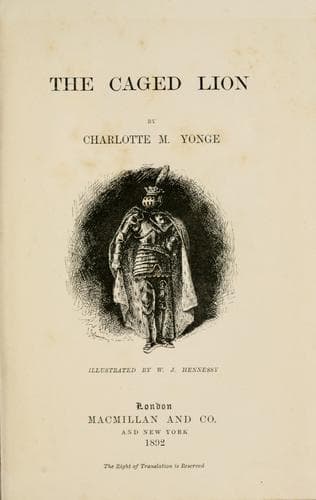
The Caged LionYonge, Charlotte M. (Charlotte Mary)
History
The Caged Lion
Yonge, Charlotte M. (Charlotte Mary)
James I, King of Scotland, 1394-1437 -- Fiction; Scotland -- History -- James I, 1406-1437 -- Fiction
So brother and sister set forth on their wandering--and truly it was a
happy journey. The weather favoured them, and their hearts were light.
Lilias, delivered from terrible, hopeless captivity, her brother beside
her, and now not a brother to be pitied and protected, but to protect her
and be exulted in, trod the heather with an exquisite sense of joy and
freedom that buoyed her up against all hardships; and Malcolm was at
peace, as he had seldom been. His happiness was not exactly like his
sister's in her renewed liberty and restoration to love and joy, for he
had known a wider range of life, and though really younger than Lily, his
more complicated history could not but make him older in thought and
mind. Another self-abnegation was beginning to rise upon him, as he
travelled slowly southwards by stages suited to his sister's powers, and
by another track than that by which he had gone. On the moor, or by the
burn side, there was peace and brightness; but wherever he met with man
he found something to sadden him. Did they rest in a monastery, there
was often irregularity, seldom devotion, always crass ignorance. The
manse was often a scene of such dissolute life that Malcolm shunned to
bring his sister into the sight of it; the peel tower was the dwelling of
savagery; the farm homestead either rude and lawless or in constant
terror; the black spaces on many a brae side showed where dwellings had
been burned; more than once they passed skeletons depending from the
trees or lying rotting by the way-side. And it was frightful to Malcolm,
after his four years' absence, to find how little Lilias shared his
horror, taking quite naturally what to Alice Montagu would have seemed
beyond the bounds of possibility, and would have set Esclairmonde's soul
on fire, while Lilias seemed to think it her brother's amiable
peculiarity to be shocked, or to long to set such things straight.
He felt the truth of James Kennedy's words--that reformation could not be
the sole work of the King, but that his hands must be strengthened by all
the few who knew that a different state of things was possible, and that,
above all, the clergy needed to be awakened into vigour and intelligence.
Formerly, the miserable aspect of the country had merely terrified him,
and driven him to strive to hide his head in a convent; but the strength
and the sense of duty he had acquired had brought his heart to respond to
Kennedy's call to work.
Public-domain text, read in full here on John Shaqi.
Reviews
Reviews
No reviews yet
Be the first to share your thoughts on this work.
Elsewhere in the archive
Join the Discussion
Join the discussion
Sign in to leave a comment or review.
Sign InorCreate an account