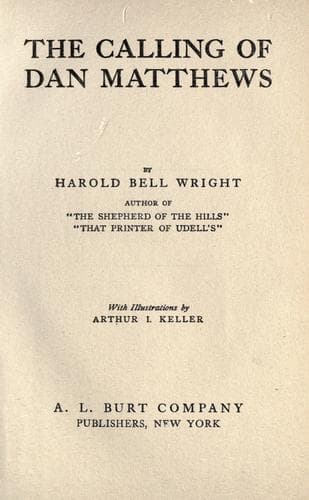
Christian fiction; City and town life -- Fiction; Clergy -- Fiction; Ozark Mountains -- Fiction
The man in the road laughed a strange, hoarse, mirthless laugh, saying as
he continued to advance, "I thought it must be you. You nearly ran me
down." And Dan climbed in by the physician's side.
The minister made no explanation, nor did his friend, after the first few
surprised questions, press him. But when they were turning in towards
Dan's gate the big fellow burst forth, "Don't stop, Harry--not here! For
God's sake, if you love me, take me on to your house for a little while!"
Then did Dr. Harry guess the truth that later he came to know.
CHAPTER XXXV.
THE TIE THAT BINDS
"The Ally was there in power. The day of the rack, the thumbscrew and
the stake, is long past: in place of these instruments of religious
discipline we have--the Ally."
All the next day Dan remained at Dr. Harry's home, returning to his own
rooms in the evening. Early the following morning he was to take the
train for the annual gathering of the denomination, that was to be held
in a distant city. He would be away from Corinth three days at least.
The minister's little study, when he had lighted the lamp that night,
seemed filled with a spirit that was never there before. It was as if,
during his absence, some unseen presence had moved in to share the
apartment with him. The very books and papers impressed him as intimate
companions, as if, in thus witnessing and--in truth--taking part in the
soul-struggle of the man, they had entered into a closer relation to
him, a relation sacred and holy. He was conscious, too, of an atmosphere
of privacy there that he had never sensed before, and, for the first
time in his life, he drew the window shades.
In the battle that Hope Farwell had set for him to fight Dan had sought
to be frankly honest with himself, and to judge himself coldly, without
regard to the demands of his heart. If he had erred at all it was in an
over-sensitiveness to conscience, for conscience has ever been a tricky
master, often betraying its too-willing slaves to their own self-injury.
It is, a large question whether one has a greater right to injure himself
than to harm another.
Dan could not admit, even to himself, that he had in any way neglected
the church, or fallen short of his duties as a hired shepherd. But after
all, was he not to some degree in error in his judgment of his people?
Had he not, perhaps, misunderstood the spirit that moved them? He had
come to Corinth from his school with the thought fixed in his mind that
the church was _all_ right. Had he not, by the unexpected and brutal
directness of his experience, been swung to the other extreme, conceiving
conditions as all wrong?
Public-domain text, read in full here on John Shaqi.
Reviews
Reviews
No reviews yet
Be the first to share your thoughts on this work.
Elsewhere in the archive
Join the Discussion
Join the discussion
Sign in to leave a comment or review.
Sign InorCreate an account