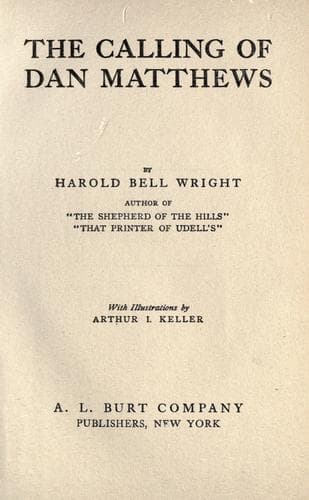
Christian fiction; City and town life -- Fiction; Clergy -- Fiction; Ozark Mountains -- Fiction
Judge Strong was an old campaigner. A heavy contributor to the general
work and missionary funds to which the leaders looked for the practical
solution of their modest bread and butter problems, he had the ears of
them all. Nor was the Elder slow to use his advantage. He could speak his
mind with frankness here, for these great men of the church lived far
from Corinth and, while knowing much of the Elder--the church man, knew
nothing of the Judge--the citizen and neighbor. More than this such
reports as the Elder had to make must, in the very nature of things, for
the good of the cause, be strictly private.
While the Judge was holding these little confidential chats with the
leaders, and the leaders were holding equally confidential chats with
their friends and favorites, and these in turn were doing as they had
been done by, the Elder's assistants, assigned to various church homes
in the city, were confidentially exchanging confidences with their
hostesses. And this is the simple truth of the whole matter, and the way
it all came about.
Dan was introduced to the secretary. "Ah--yes, Brother Matthews of
Corinth! Glad to meet you. Ah, excuse me I--ah, see a brother over there
with whom I must speak."
Dan was presented to the treasurer. "Oh yes, I have heard of you--at
Corinth. Why, hello, Brother Simpkins"--catching a passing preacher by
the arm--"glad to see you! How are you and how is the work?"
Dan introduced himself to one or two of those whom he had hungered to
see, those who were noted in the church papers for their broad wisdom
and saintly character, and somehow Dan felt rebuked for his forwardness
when each, from his pedestal, looked at him and said, "Oh yes; Brother
Matthews! I have heard of you, Brother Matthews!"
During the forenoon session of the second day the order of business was
reports of the churches. In response to roll call, one after the other,
the representatives of the various congregations would tell what they
had done and what they were going to do. Dr. Oldham remarked later, "No
one told what they had failed to do, or what they were not going to do."
As a rule the ministers reported for their own churches, save when some
delegate whom the pastor knew to be peculiarly qualified, was present.
Generally speaking the ministers consider the value of such a report to
be greatly increased if it can be given by some such member. The minister
himself always sees that the report is properly prepared.
Public-domain text, read in full here on John Shaqi.
Reviews
Reviews
No reviews yet
Be the first to share your thoughts on this work.
Elsewhere in the archive
Join the Discussion
Join the discussion
Sign in to leave a comment or review.
Sign InorCreate an account