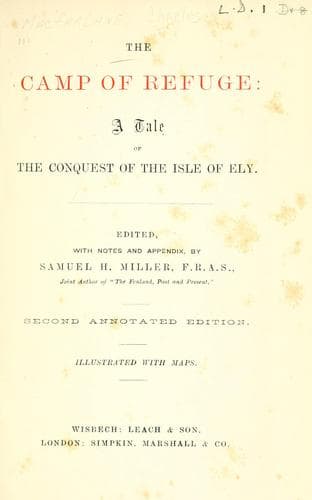
The Camp of Refuge: A Tale of the Conquest of the Isle of ElyMacFarlane, Charles
History
The Camp of Refuge: A Tale of the Conquest of the Isle of Ely
MacFarlane, Charles
Great Britain -- History -- Medieval period, 1066-1485 -- Fiction
“No vows for me,” said Elfric, “but vows to serve my country, and
vows to love thee, oh Mildred! I was not meant to be a
cloister-monk—albeit, if the Normans had not come into the fen
country, and I had never been sent on the business of the Spalding
cell to the house of thy mistress, and had never seen thee, fair
Mildred, I might in all possibility have submitted quietly to the
manner of life which had been chosen for me. But these accidents
which have happened have made me feel that I love fighting better
than praying, and loving much better than fasting. My superiors have
all come to the same conclusion, and have liberated me, and have
given me to the brave and bountiful Lord Hereward to be his page and
sword-bearer, and whatsoever he may please to make me.” Maid Mildred
tried to check her tongue, and to look composed or indifferent; but
not being well practised in the art of concealing her feelings, she
set up a cry of joy, and then falling on her knees she inwardly and
silently thanked heaven that Elfric was not to be a monk, or one that
could not be loved by her without sin. Perhaps the ex-novice
understood what was passing in her mind; and perhaps he did not: for
when he raised her up by her hand, and kept her hand closed within
his own, and looked in her bright blue eyes, he said, “Mildred, art
thou glad, indeed, at this my change of condition? Art thou, indeed,
happy that I should be a soldier, fighting for the good English
cause, and a sword-bearer constantly in attendance on the brave and
bountiful Lord of Brunn, to go wherever he goeth, and to dwell with
him in mansion and hall, when the battle is over and the camp struck;
or wouldst thou have me back in the house at Spalding, and a monk for
all my days?”
“It seemeth to me that when devout and learned men have opined that
thou art fitter for a soldier than for a monk, it is not for a weak
unlettered maid like me to gainsay it. In sooth thou lookest
marvellously well in that soldier jerkin and baldric; and that plumed
cap becomes thy merry face better than the hood. Thou carriest that
sword too by thy side with a better grace than ever thou didst carry
missal or breviary. But—but—alack and woe the while!—soldiers get
killed and monks do not! Elfric, thou wert safer in thy cell.”
Public-domain text, read in full here on John Shaqi.
Reviews
Reviews
No reviews yet
Be the first to share your thoughts on this work.
Elsewhere in the archive
Join the Discussion
Join the discussion
Sign in to leave a comment or review.
Sign InorCreate an account