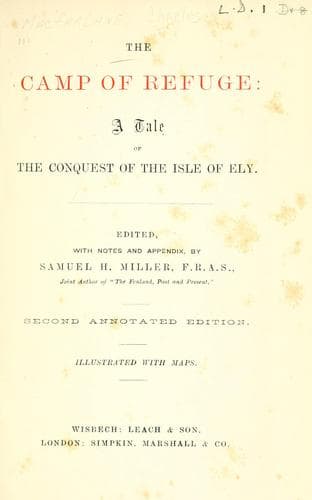
The Camp of Refuge: A Tale of the Conquest of the Isle of ElyMacFarlane, Charles
History
The Camp of Refuge: A Tale of the Conquest of the Isle of Ely
MacFarlane, Charles
Great Britain -- History -- Medieval period, 1066-1485 -- Fiction
It was agreed on all sides that too much happiness had been lost
already in their long separation, and that Alftrude and Hereward ought
now to be married as quickly as possible; the great heiress whose lands
were so coveted could be safe only under the protection of a warlike
lord and devoted husband; and who was there in the land so brave and
likely to be so devoted as the Lord of Brunn, who had known and loved
her from his youth, and who had gotten her troth-plight? If the ladie
remained single, and the fortune of war should prove for a season
unfavourable, the Normans, by mixing fraud with force, might carry her
off, as they carried off and forcibly wedded other English heiresses;
but if she were once united to Hereward, even the Normans might
hesitate ere they broke the sacred tie of the Church. Time was not
needed for wooing, for there had been good and long wooing long ago;
and but for the Normans would not Hereward and Alftrude long since have
been husband and wife?[143] Thus reasoned all the kinsmen and kinswomen
of the Ladie Alftrude; and yielding to their good advice, the Saxon
heiress consented that her good old household priest should prepare the
little church on the hill by the linden-grove, and that the wedding
should take place on the morrow.
Hereward was urged by a pleasant spirit of revenge to be thus urgent;
for Ivo Taille-Bois was coming on the morrow with his men-at-arms and
with his brother Geoffroy, that unmannerly and unlucky wooer; and so
the Lord of Brunn would fain bid them to his marriage feast, if so it
might be. But Hereward kept this pleasant thought to himself, or
explained it to none but Elfric and Girolamo of Salerno. The morning
after that happy meeting in the linden-grove was a bright winter’s
morning. The sun rarely shines so bright in the summer time in the fen
country. The little church was ready, the good old English priest was
robed and at the altar; the path leading from the manor-house to the
church, in lack of flowers, was strewed with rushes, and the serfs of
the Ladie Alftrude were ranged on either side of the path; the lady
herself was attired[144] as became a bride (a Saxon bride in the good
old time before our fashions were corrupted); her fair young kinswomen,
who were to stand by her side at the altar, were dressed and ready, and
all other persons and things were ready about two hours before noon.
There was music and there were fresh shouts of joy in the hall and
outside of the manor-house when Lord Hereward stepped forth with his
blushing bride on his arm and headed the gay procession. But though
gay, the attendance was not so great as it might have been, for a great
many of the armed men were not there, and even the sword-bearer and the
Salernitan were both absent. Maid Mildred thought it very strange and
very wrong that Elfric should be away at such a happy juncture; but the
truth is that Elfric and Girolamo, and many of the fighting men, had
something else to do.
Public-domain text, read in full here on John Shaqi.
Reviews
Reviews
No reviews yet
Be the first to share your thoughts on this work.
Elsewhere in the archive
Join the Discussion
Join the discussion
Sign in to leave a comment or review.
Sign InorCreate an account