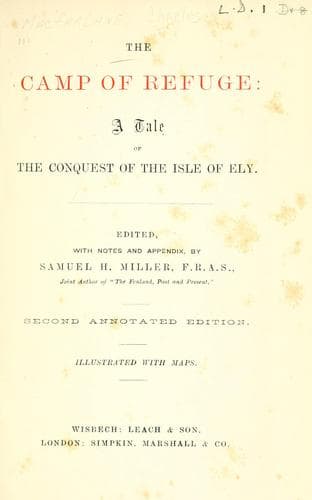
The Camp of Refuge: A Tale of the Conquest of the Isle of ElyMacFarlane, Charles
History
The Camp of Refuge: A Tale of the Conquest of the Isle of Ely
MacFarlane, Charles
Great Britain -- History -- Medieval period, 1066-1485 -- Fiction
A scant mile beyond the church hill and the linden-grove there ran a
narrow but very deep stream, which was crossed by an old wooden bridge.
All persons coming from Stamford must pass this river; and Hereward had
been properly advised of all Ivo’s intentions and of all his movements.
Girolamo had been hard at work over-night upon the bridge, and by his
good science the timbers of the bridge were so cut into pieces and put
together again, that he could allow any given number of persons to
cross, and then by a simple operation disjoint the bridge and pull it
to pieces so that no more should pass. To contain the water within its
bed some broad embankments of earth had been made in very old times
near to the bridge; and under cover of these embankments nearly all the
armed Saxons had been mustered by Lord Hereward at a very early hour in
the morning, yet not until divers other traps and pitfalls had been
prepared for the Normans. As the Lord of Brunn and the Ladie Alftrude
were walking from the manor-house to the church, the good men lying in
ambush by the river side discovered a great troop pressing along the
half-inundated road towards the bridge. These Normans had not been able
to get their horses across the fens, and therefore were they all coming
on afoot, cursing the bogs and pools and making a loud outcry when they
ought all to have been silent. Girolamo and Elfric, who were holding
some coils of rope in their hands behind the embankment, presently
heard Ivo Taille-Bois say to his brother, “Vive Notre Dame, the wooden
bridge is standing! The fools have not had wit enough to see that it
ought to be cut down! Set me down this Hereward for an ass! Come on
Geoffroy, this detestable footmarch is all but over. Behind that hill
and grove stands thy manor-house, and therein thy bride.”
“We shall soon see that,” said Elfric to himself, “and thou shalt soon
see whose bride the Ladie Alftrude is.”
Public-domain text, read in full here on John Shaqi.
Reviews
Reviews
No reviews yet
Be the first to share your thoughts on this work.
Elsewhere in the archive
Join the Discussion
Join the discussion
Sign in to leave a comment or review.
Sign InorCreate an account