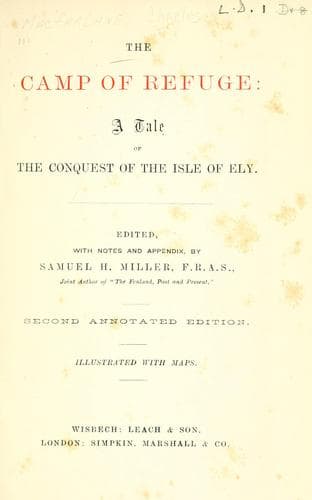
The Camp of Refuge: A Tale of the Conquest of the Isle of ElyMacFarlane, Charles
History
The Camp of Refuge: A Tale of the Conquest of the Isle of Ely
MacFarlane, Charles
Great Britain -- History -- Medieval period, 1066-1485 -- Fiction
“’Tis well thought,” replied Hereward, “for I have small time to lose
in parley. This is my wedding day, Sir Geoffroy. My bride, the Ladie
Alftrude, is in the church, and the priest is waiting for me with open
book at the altar. My humour is that thou and thy brother shall be
witnesses to our marriage ceremony. Come, my good Saxons, drag me this
pond, and pull out those big Norman fish!”
A score of Saxons instantly threw strong fishing-nets and coils of rope
across the pool. The men-at-arms, seeing that quarter was to be given,
gladly caught hold of the ropes, and so were landed; but the mention of
the marriage, and of Hereward’s humour to have them both present at it
as witnesses, had so filled the minds of Ivo and his brother with
trouble and shame, that they caught neither at the ropes nor at the
nets, seeming to prefer tarrying where they were to going up to the
church. The Lord of Brunn waxed impatient; and making a sign to Elfric,
that nimble sportsman threw a noose over the surface of the pool, and
threw it with so good an aim that he caught Geoffroy round the neck;
and then giving his coil a good tug, which brought the head of the
unlucky rival of his master under water, Elfric shouted, “Come out,
thou false Norman, come out, and to the wedding, or be drowned or
hanged—I care not which.”
Geoffroy, thus hardly entreated, waded and struggled to the brink as
best he could, and was there pulled out all covered with mud, or with
the green mantle of the pool. Ivo, apprehending a rope round his own
neck, caught hold of one of the nets that the shouting and laughing
Saxons kept throwing at him, and he too was dragged out of the water,
all bemired or green, and almost breathless.
Such of the men-at-arms as had kept their weapons had laid them at the
feet of Lord Hereward, in token of unconditional surrender. Geoffroy,
the unlucky wooer, had no weapon to give up, having left his sword in
the pool; but his brother Ivo had his broad blade at his side, and when
called upon to surrender it, he made a wry face and said that a knight
ought to surrender only to a knight, meaning hereby to taunt the Lord
of Brunn with his not having been admitted into the high military
confraternity.
“Ivo,” said Hereward, “I told Raoul, that dispossessed usurper and
robber, and I now tell thee, that I shall soon be a knight, meaning
that I shall be one according to usage and rites and ceremonies. True
knighthood is in the heart and soul of man, and not in the ceremonies.
Were I not already a truer knight than thou, I would hang thee and thy
brother to these willow-trees, and butcher thy men here, even as too
many of ye Normans have butchered defenceless Saxon prisoners after
surrender. Give up thy sword, man, or it may not be in my power to save
thee from the fury of my people! Give up thy sword, I say!”
Public-domain text, read in full here on John Shaqi.
Reviews
Reviews
No reviews yet
Be the first to share your thoughts on this work.
Elsewhere in the archive
Join the Discussion
Join the discussion
Sign in to leave a comment or review.
Sign InorCreate an account