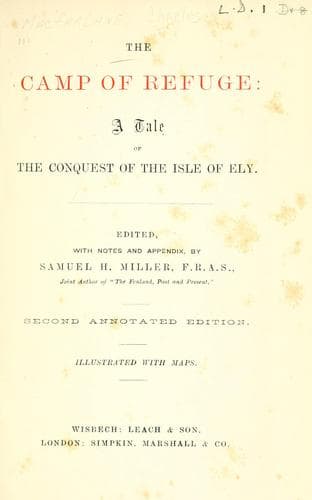
The Camp of Refuge: A Tale of the Conquest of the Isle of ElyMacFarlane, Charles
History
The Camp of Refuge: A Tale of the Conquest of the Isle of Ely
MacFarlane, Charles
Great Britain -- History -- Medieval period, 1066-1485 -- Fiction
By the octave of the Epiphany, being the thirteenth day of the
Wolf-month, or kalends of January, and the day of Saint Kentigern, a
Saxon abbat and confessor, the Lord of Brunn was at the Abbey of
Peterborough with more than two hundred well-armed Saxons! and on that
very night—a night of the happiest omen—was begun his initiation in
the old abbey church. First, Hereward confessed himself to the prior,
and received absolution. After this he watched all night in the church,
fasting and praying. At times a cloister monk prayed in company with
him; but for the most part he was left alone in the ghostly silence of
the place, where light was there none save the cressets that burned
dimly before the effigies of his patron saint. But while he knelt
there, Elfric his faithful sword-bearer stood guard outside the door of
the church, whiling away the time as best he could, by calling to mind
all the legends and godly stories connected with the Peterborough Abbey
and its first founders, and _specialiter_ that marvellously pretty
miracle which Saint Chad performed in the presence of his recent
convert King Wolfere. Which miracle was this, according to the faithful
relation of Walter of Whittlesey, a monk of the house: One day, after
praying a long while with King Wolfere in his oratory, the weather
being warm, Saint Chad put off his vestment and hung it upon a sunbeam,
and the sunbeam supported it so that it fell not to the ground; which
King Wolfere seeing, put off his gloves and belt, and essayed to hang
them also upon the sunbeam, but they presently fell to the ground,
whereat King Wolfere was the more confirmed in the faith.[160] In the
morning, at the hour of mass Hereward placed his sword upon the high
altar; and when mass had been said, and he had confessed himself and
been absolved again, the Lord Abbat took the now hallowed sword and put
it about Hereward’s neck with a benediction, and communicating the holy
mysteries, finished the simple and altogether religious ceremonial: and
from thenceforward Hereward remained a lawful soldier and Saxon knight.
In the good Saxon times men were never so vain and sinful as to believe
that a knight could make knight, or that any lay lord, or even any
sovereign prince or king, could give admittance into the confraternity
of knights by giving the accolade with strokes of the flat of the sword
upon the shoulders and with the tying on of spurs and hauberks, and the
girding on the sword, and such like vanities. These things were brought
in among us by the Normans; and being brought in, our knights lost
their religious character, and ceasing to be the defenders of the
church, and the protectors of all that wanted protection, they became
unhallowed oppressors, depredators, barefaced robbers, and the scourges
of their kind. And it was so at the very first that these Normans did
affect to contemn and abhor our old Saxon custom of consecration of a
soldier, calling our Saxon knights in derision priest-made knights and
Public-domain text, read in full here on John Shaqi.
Reviews
Reviews
No reviews yet
Be the first to share your thoughts on this work.
Elsewhere in the archive
Join the Discussion
Join the discussion
Sign in to leave a comment or review.
Sign InorCreate an account