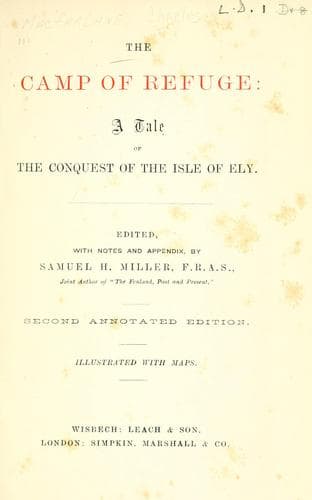
The Camp of Refuge: A Tale of the Conquest of the Isle of ElyMacFarlane, Charles
History
The Camp of Refuge: A Tale of the Conquest of the Isle of Ely
MacFarlane, Charles
Great Britain -- History -- Medieval period, 1066-1485 -- Fiction
And when the fire which Girolamo had lit had burned itself out, and the
smoke had cleared away, the fierce wind fell and there came on a
terrible storm of thunder and lightning; and when this was over the
long delayed rains began to fall in torrents, filling the rivers and
brooks and marshpools, and making the whole country once more
impassable; and these rains, intermitting only for brief hours,
continued to fall for seven days and seven nights; and that part of the
causeway which had been built by Duke William’s orders was undermined
and washed away, so that no trace remained of it. And then, while the
Normans remained penned up in the castle and in the intrenched camp,
the Lord of Brunn and his Saxons launched their light boats in the
rivers and meres, and destroyed all the works which had been built to
defend the whole road. Thus in the next year the Conqueror had
everything to begin anew. In the meanwhile Ivo Taille-Bois gave up the
command in despair, and went away to Stamford, where he had left his
wife, the Ladie Lucia. During the winter this Vicomte of Spalding made
an essay to recover possession of the Ladie Lucia’s manor-house and
estates at Spalding; but as the Saxons had still a little fleet of
barks and the entire command of the Welland river, Ivo failed entirely,
and was not even able to do so much as disturb the tranquillity of the
good Saxon monks of Crowland. And while the Norman vicomte was thus
unsuccessful, other and great successes attended the Saxon lord. With
one numerous band collected near his house at Brunn, the Lord Hereward
found his way across the country as far as Newark, where he defeated a
great body of Normans, and found good spoil; and after this, with
another band, drawn mostly from the impenetrable bogs of Hoilandia, he
ascended the Witham as far as Boston and there surprised and captured
three Norman knights, and some three-score Norman men-at-arms. And it
so chanced that among these three knights was that unlucky wooer
Geoffroy, the brother of Ivo, who had found in some upland part of
England a Saxon wife and heiress, but one neither so handsome nor so
rich as the Ladie Alftrude, for it was a widow quite old enough to be
Sir Geoffroy’s mother, and her whole estate was not much larger than
one of the Ladie Alftrude’s farms. Having no money to pay for his
ransom, and his brother having none to give or lend him, Geoffroy was
sent into the fens and kept there as a close prisoner. And before the
Lord of Brunn had done, he made other members of that family know what
it was to live among the bulrushes. But now, having done all these
things, and performed many other exploits, Hereward, at the approach of
spring, brought his fair young spouse from Ely to his house at Brunn,
and a very few days after her arrival the lady gave birth[208] to an
heir to the united honours of Brunn and Ey. And hereupon followed high
rejoicings, and a christening, and such an hospitable feast as only
true Saxon lords knew how to give.
Public-domain text, read in full here on John Shaqi.
Reviews
Reviews
No reviews yet
Be the first to share your thoughts on this work.
Elsewhere in the archive
Join the Discussion
Join the discussion
Sign in to leave a comment or review.
Sign InorCreate an account