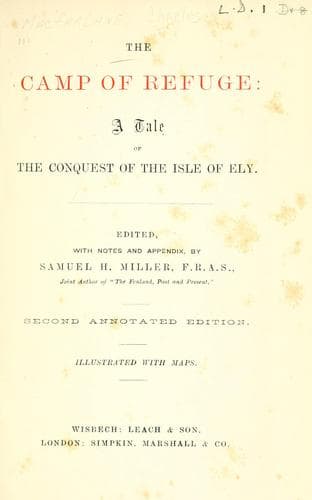
The Camp of Refuge: A Tale of the Conquest of the Isle of ElyMacFarlane, Charles
History
The Camp of Refuge: A Tale of the Conquest of the Isle of Ely
MacFarlane, Charles
Great Britain -- History -- Medieval period, 1066-1485 -- Fiction
And William rose and withdrew to the innermost room, and those who had
the right followed, and the chamberlains closed the door and kept guard
on the outside, and the heavy door-curtains were drawn within so that
none might approach the door, and not even the chamberlains hear what
passed inside. That secret council lasted till a late hour of the
evening. The words which were said be not known, but the things
determined upon were made known but too soon. It was the eve of Saint
Mark the Evangelist, and, before the feast of Saint Bede the Venerable,
Duke William was again at Cam-Bridge, and with a far greater army and
train than he had sent thither the preceding year; and at the same time
a great fleet of ships and barks began to be prepared in the London
river. No more witches were sent for, but William called over many more
experienced warriors from France, and ordered barks to be equipped in
the rivers and ports of Normandie. The traitorous Dane had told him
that he must leave his war horses in their stalls, and think of ships
and boats, if he would drive the amphibious Saxons out of the
Fen-country.
While the banner of William floated over the Julius Tower, or Keep, on
the tall mound by Cam-Bridge, country hinds and labourers of all sorts,
and horses and draught oxen, and mules and asses too numerous to count,
were collected within the fortified camp; and again timber and stones
and burned bricks were brought from all parts of the land, and in
greater abundance than before. For several weeks nothing was heard but
the sawing of wood and the hewing and chipping of stone, and a loud and
incessant hammering. A stranger to the history and present woes of
England might have thought that the Normans were going to build a Tower
of Babel, or that, penitent for the mischief they had done, they were
going to rebuild the town at Cam-Bridge, in order to bring back the
affrighted muses, and the houseless professors of learning, and the
pining English students, to sumptuous inns and halls. In truth, there
seemed work and stuff enough to furnish out a great city altogether
new. But, upon a near view, a knowing eye would have seen that all this
toil was for the making of engines of war, of towers to place along the
causeway, of bridges to throw across the streams, and of other
ponderous machines to aid the Normans in crossing the fens, and in
carrying the horrors of war into the last asylum of Saxon liberty.
Public-domain text, read in full here on John Shaqi.
Reviews
Reviews
No reviews yet
Be the first to share your thoughts on this work.
Elsewhere in the archive
Join the Discussion
Join the discussion
Sign in to leave a comment or review.
Sign InorCreate an account