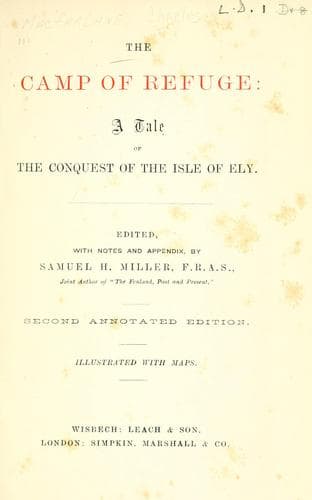
The Camp of Refuge: A Tale of the Conquest of the Isle of ElyMacFarlane, Charles
History
The Camp of Refuge: A Tale of the Conquest of the Isle of Ely
MacFarlane, Charles
Great Britain -- History -- Medieval period, 1066-1485 -- Fiction
“By Saint Etheldreda,” said Abbat Thurstan, “these ends and objects
cannot be sinful! and as sinful means can be employed only for sinful
ends, so can righteous ends be served only by righteous means. Fire
mingles with fire, and water with water: but fire and water will not
mingle or co-exist.” And divers of the cloister-monks, who had never
been touched by the venom that was about to ruin the house of Ely and
the whole country of England, took up and repeated the Abbat’s words,
speaking also of the facts in evidence, as that Girolamo the Salernitan
had many times conferred great benefit on the Saxon cause, and the
like. And even some of the house who had turned too ready an ear to
their own fears, or to the evil and crafty whisperings and suggestions
of the prior and his faction, assented to Thurstan’s proposition, and
said that verily it appeared the Salernitan was free from the damnable
guilt wherewith he was charged, and that if he had used any magic at
all, it was only that Magia Alba, or White Magic, which proceeded from
the study and ingenuity of man, and which might be used without sin.
Now as these things were said in the hall, the prior, fearing that his
plot might be counter-plotted, and the meshes he had woven be torn to
pieces, and blown to the winds, waxed very desperate; and, after
whispering for awhile in the ear of the chamberlain who sat by him, he
threw his cowl back from his head, and standing up, spoke passionately.
But while the prior spoke he never once looked at Girolamo, who
remained standing in the middle of the great hall, firm and erect, and
with his arms crossed over his breast. No! desperate as he was, the
prior could not meet the fiery glances of that dark thin man; and so he
either looked at the round and ruddy face of Thurstan, or in the faces
of those monks of his own faction who had made up their minds to
support him in all that he might say or do.
“It seemeth to me,” said the prior, “that a wicked man may pretend to
serve a good cause only for the sake of injuring it, and that a weak
man may be brought to believe that good can come out of things that are
evil, and that witchcraft and all manner of wickednesses may be
employed against an enemy, albeit this is contrary to the doctrine of
our Church, and is provocative of the wrath of Heaven. Now, from the
first coming of this alien among us, things have gone worse and worse
with us. Not but that there have been certain victories and other short
glimpses of success, meant only to work upon our ungodly pride, and
delude us and make our present misery the keener. When this alien first
came, the Lord Abbat liked him not—I need not tell ye, my brethren,
that the Lord Abbat said to many of us, that he liked not the looks of
the stranger the Lord Hereward brought with him; or that I and the
cellarius, and many more of us, thought from the beginning that the man
was a Jew—an Israelite—yea, one of that accursed race that crucified
our Lord!...”
Public-domain text, read in full here on John Shaqi.
Reviews
Reviews
No reviews yet
Be the first to share your thoughts on this work.
Elsewhere in the archive
Join the Discussion
Join the discussion
Sign in to leave a comment or review.
Sign InorCreate an account