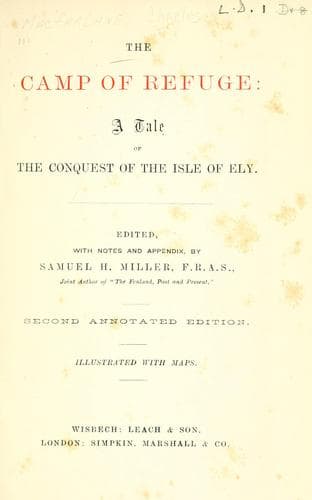
The Camp of Refuge: A Tale of the Conquest of the Isle of ElyMacFarlane, Charles
History
The Camp of Refuge: A Tale of the Conquest of the Isle of Ely
MacFarlane, Charles
Great Britain -- History -- Medieval period, 1066-1485 -- Fiction
“’Tis well imagined,” said the chamberlain in another whisper; “but we
must undo the effect of that devil Girolamo’s speech, and prepare the
minds of the monks for the work we would have them do.”
While the prior and the chamberlain were thus whispering together,
divers of the old monks, who loved not their faction and who had grown
weary of this long sitting, quitted the hall without leaving the mantle
of their wisdom and experience behind them; and after their departure
the prior and his faction so perplexed the dull wits of the honester
part of the community, that they again began to believe that the
Salernitan was a necromancer and the abbat his fautor, that there was
no hope of getting corn or wine unless they submitted to Duke William,
and that if they did not submit they would all be murthered by the
Normans.
They also spoke, and at great length, of the privations they had
undergone ever since the beginning of the war.
“Yea! how long and how manifold have been our sufferings,” said the
sub-sacrist. “When this accursed Camp first began to be formed, was not
our house entirely filled with guests? Did they not seize upon our
hall, nay, even upon our kitchen? And were not we of the convent
obliged to take our meals in the dormitory, as well on flesh days as on
fish-days? Were not all open spaces in the monastery crowded, so that
the abbey looked more like a fair than a house of religion? Was not the
grass-plot of the cloisters so trampled down by the feet of profane
fighting-men that no vestige of green was to be seen upon it? And
though most of these guests be now gone into the Camp, because there is
little left here for them to devour, do not the cellars, the
store-houses, the kitchen, and every part of the house speak of their
having been here, and of the poverty and disorder in which they have
left us?”
“Aye,” said the refectorarius, “wonderful hath been the waste! The
revenue of the abbat, the common property of the house, and the
incomings allotted to the several officials to enable them to bear the
charges and do the duties of their offices, have all been anticipated
and consumed! And let our improvident Abbat tell me how I am to find
that which I am bound to provide for the whole convent to wit, pots,
noggins, cups, table-cloths, mats, basons, double-cloths, candlesticks,
towels, plates, saltcellars, silver plates wherewith to mend the cups
that be broken, and the like; besides furnishing three times in the
year, to wit, at All Saints, Christmas, and Easter, five burthens of
straw to put under the feet of the monks in the refectory, and five
burthens of rushes and hay wherewith to strew the hall?”
Public-domain text, read in full here on John Shaqi.
Reviews
Reviews
No reviews yet
Be the first to share your thoughts on this work.
Elsewhere in the archive
Join the Discussion
Join the discussion
Sign in to leave a comment or review.
Sign InorCreate an account