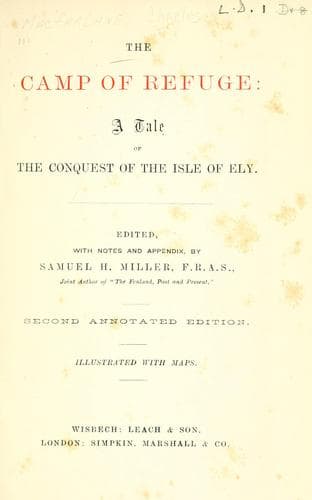
The Camp of Refuge: A Tale of the Conquest of the Isle of ElyMacFarlane, Charles
History
The Camp of Refuge: A Tale of the Conquest of the Isle of Ely
MacFarlane, Charles
Great Britain -- History -- Medieval period, 1066-1485 -- Fiction
He began with the Norman houses. Here the Saxon
serfs, though somewhat alarmed when first roused from their deep sleep,
not only threw open their doors with alacrity, but also led Elfric’s
people to the cellars and store-houses. Nay, upon a little talk with
the fen-men, and after an agreement made between them that the doors
should be broken as if violence had been used, and some resistance
attempted, they threw open all parts of the houses, stables, and
outhouses, and assisted their countrymen in packing up their booty, in
harnessing the horses and asses, as well as in other necessary offices.
Not a murmur was heard until they came to visit some of the houses of
the freed-men of Dereham. These men, who had some small stores of their
own, were more angered than comforted by being told that the corn was
to make bread for the monks of Ely; for, strange and wicked as it may
appear, it was nevertheless quite true, that in Dereham the translation
of Saint Withburga’s body had never been forgiven, but was still held
as a piece of cheating and thievery, notwithstanding the heavenly bot
or compensation of the miraculous well, and in spite of King Edgar’s
charter, and the subsequent approval of our lord the Pope, and maugre
the fact obvious to all men that the saint was better lodged at Ely
than ever she could have been in this little church. In truth, those
freemen made an exceeding great clamour. “To the devil with the monks
of Ely for us,” said they. “In the bygone times they came to Dereham
and treacherously stole away the body of our saint by night, and now
they send armed men to break upon our sleep and carry off our grain!”
Elfric bade them remember and mind that the Lord Abbat of Ely was lord
and proprietor of Dereham, and that they were or ought to be his liege
men; and as they continued to complain, and to say that they wished the
Normans would soon get back from Swaffham and Castle Acre, Elfric broke
the pates of two or three of them with one of their own staves. But
nowhere could these men do more than grumble; their numbers being but
small, and the serfs being mostly on the other side: moreover, arms had
they none, their friends the Normans having taken care of that. Having
found cattle enough elsewhere, Elfric would not molest the mass-priest,
who slept so soundly that he heard nothing of what was passing, and
knew nothing of the matter until Elfric had gotten down to the little
Ouse, or twenty good miles from Dereham.
It was midnight when the fen-men arrived at Dereham town, and before
prime they were below Brandon, and loading their boats with the corn
and wine which had previously loaded a score of good upland
pack-horses, and more than a score of dapple asses. “This,” said
Elfric, “is not a bad lift for one night’s work! I should like to see
the face of the Normans when they return from Swaffham and Castle Acre
into Dereham!”
Public-domain text, read in full here on John Shaqi.
Reviews
Reviews
No reviews yet
Be the first to share your thoughts on this work.
Elsewhere in the archive
Join the Discussion
Join the discussion
Sign in to leave a comment or review.
Sign InorCreate an account