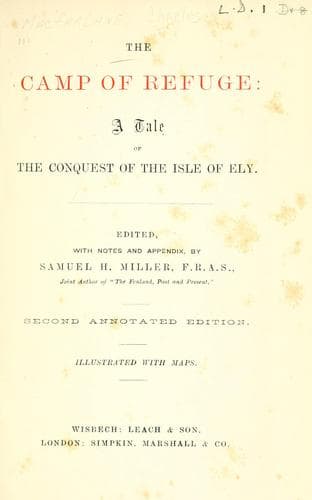
The Camp of Refuge: A Tale of the Conquest of the Isle of ElyMacFarlane, Charles
History
The Camp of Refuge: A Tale of the Conquest of the Isle of Ely
MacFarlane, Charles
Great Britain -- History -- Medieval period, 1066-1485 -- Fiction
The Saxons blew their horns as loud as they could blow them, meaning
the blasts to be as much a note of defiance to the enemy as a signal to
their friends; and the Norman trumpeter kept blowing his brazon and
far-sounding trumpet, and the Norman cavaliers kept charging along the
road, shouting and cursing and calling the Saxons thieves and
cowards—which they had no right to do. As the enemy came near, the
Saxons set up a shout, and the scared horses and asses tied together on
the road, set up their heels with such a kicking and braying and
neighing as were never seen and heard; and up started from the sedge by
the river bank the score of good Saxon archers that had gone a little
up the river in the boats, and whiz went their arrows into the bowels
of the horses the Normans were riding, and every arrow that did not
kill, disabled some horse or man, the archers in the sedges being too
near their aim to throw away a single arrow. The knight in command
ordered the trumpeter to sound a retreat, but before the man could put
the brass to his lips, a shaft went through his cheeks and spoiled his
trumpeting for aye. But the Normans showed that they could run without
sound of trumpet; and away galloped the valorous knight to bring up his
bowmen. These Norman archers had no great appetite for the business,
and albeit they were told there was a great treasure to be gotten, they
stood at a distance, looking now down the road, and now down the river,
and now across the ditch and the plashy meadows beyond it; and thus
they stood at gaze until they heard a round of Saxon cheers, and the
too well-known war-cry of “Hereward for England!” and until they saw a
warlike band advancing towards Brandon by the opposite bank of the
river. A cockle shell to a mitre—but they tarried not long then! Away
went the Normans, horse and foot, as fast as they could go through
Brandon town and back upon the high road by which they had marched from
Thetford.
“Ha! ha!” cried the Lord of Brunn to his friends from across the river;
“what new wasps’ nest is this ye have been among?”
The sword-bearer replied that it was a Norman force which had been
marching from the south-east.
“’Tis well,” said Hereward; “and I see ye have made good booty, and so
all is well on your side. On our side we have led the Normans from
Dereham and thereabouts a very pretty dance. I drew a party of them
after me into the fens and cut them off or captured them to a man. I
count as my prisoners one rash young knight and fifteen men-at-arms.”
“We have loaded and brought hither more than a score of asses and a
full score of pack-horses. Shall we finish loading? All the wine is
here, and a good deal of the corn, and—”
“But shall we not pursue?” cried Girolamo. “Those Normans that came on
so boldly are now running like sheep. By moving across this marsh, as
light fen-men move, we shall be sure to cut off a part of them.”
Public-domain text, read in full here on John Shaqi.
Reviews
Reviews
No reviews yet
Be the first to share your thoughts on this work.
Elsewhere in the archive
Join the Discussion
Join the discussion
Sign in to leave a comment or review.
Sign InorCreate an account