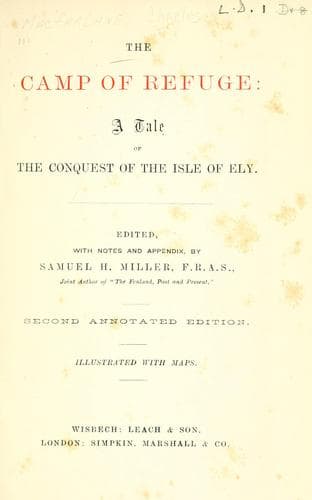
The Camp of Refuge: A Tale of the Conquest of the Isle of ElyMacFarlane, Charles
History
The Camp of Refuge: A Tale of the Conquest of the Isle of Ely
MacFarlane, Charles
Great Britain -- History -- Medieval period, 1066-1485 -- Fiction
The crowd rushed in. It was made up of hinds and serfs from the
township of Ely, and of the gaping novices and lay brothers and serving
men of the abbey; but in the head of it was an old fenner, who dwelt on
the Stoke river between Hilgay and Downham-market, and who was well
known for his skill in fowling and decoying birds, and for no other
good deed: his name was Roger Lighthand, and he was afterwards hanged
for stealing. He had his tale by rote, and he told it well. He was
going that morning to look after some snares near Stoke-ferry, when, to
his amazement, he saw a great band of Normans marching across the fens
under the guidance of some of the fenners. He concealed himself and the
Normans concealed themselves: and soon afterwards there came a band of
Saxons headed by the Lord of Brunn, and these Saxons fell into the
ambush which the Normans had laid for them; and the Lord of Brunn,
after a desperate fight, was slain, and his head was cut off by the
Normans and stuck upon a spear; and then the Normans marched away in
the direction of Brandon, carrying with them as prisoners all the
Saxons of Lord Hereward that they had not slain—all except _one_ man,
who had escaped out of the ambush and was here to speak for himself.
And now another fenner opened his mouth to give forth the lies which
had been put into it; and this man said that, early in the morning, the
Lord of Brunn, with a very thin attendance, had come across the fens
where he dwelt, with a great blowing of horns, and with sundry gleemen,
who sang songs about the victories of Hereward the Saxon, and who drew
all the fenners of those parts, and himself among the rest, to join the
Lord of Brunn, in order to march with him to the upland country and get
corn and wine for the good monks of Ely. “When the Lord Hereward fell,”
said this false loon, “I was close to him, and I afterwards saw his
head upon the Norman lance.” “And I too,” quoth Roger Lighthand, “from
my hiding-place among the rushes, saw the bleeding head of the Lord of
Brunn as plainly as I now see the face of the Lord Abbat!”
The traitorous monks made a loud lamentation and outcry, but Thurstan
could neither cry nor speak, and he sate with his face buried in his
hands; while the prior ordered the crowd to withdraw, and then barred
the door after them. As he returned from the door to his seat, the
prior said, “Brethren, our last hope is gone!” And every monk then
present, save only three, repeated the words, “Our last hope is gone!”
“The great captain hath perished,” said the chamberlain: “he will bring
us no corn and wine! There is no help for us except only in tendering
our submission to _King_ William, and in showing him how to get through
the fens and fall upon the _rebel_ people in the Camp of Refuge, who
have consumed our substance and brought us to these straits!”
Many voices said in a breath that there was no other chance of escaping
famine or slaughter.
Public-domain text, read in full here on John Shaqi.
Reviews
Reviews
No reviews yet
Be the first to share your thoughts on this work.
Elsewhere in the archive
Join the Discussion
Join the discussion
Sign in to leave a comment or review.
Sign InorCreate an account