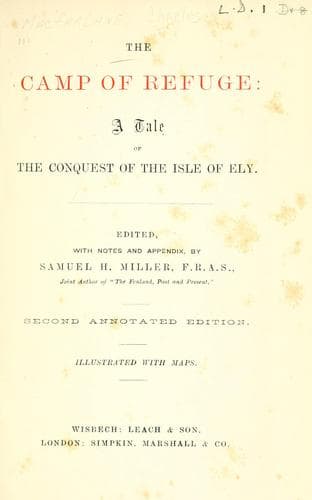
The Camp of Refuge: A Tale of the Conquest of the Isle of ElyMacFarlane, Charles
History
The Camp of Refuge: A Tale of the Conquest of the Isle of Ely
MacFarlane, Charles
Great Britain -- History -- Medieval period, 1066-1485 -- Fiction
While Thurstan, a sadder man than ever was Marius among the ruins of
Carthage, was thus standing motionless, and communing with his own sad
heart, the prior put to the vote the resolution which the chamberlain
had moved; and the large majority of the house, some being deep in the
plot, but more being carried by the dread of the Normans and the dread
of famine, or being thrown into despair by the reported death of the
Lord of Brunn, voted as the prior and chamberlain wished they would
vote. The prior would fain have cast Thurstan into that subterranean
dungeon into which Thurstan had once threatened,[237] but unluckily
only threatened, to cast him; and he took much pains to show that it
was needful to keep the deposed abbat in a place of great strength and
security, to keep his imprisonment a secret, and to prevent all
possibility of access to him or correspondence with him; but when he
came to name the dark damp cold cells in the foundations of the abbey,
wherein the rebellious son of an old East Anglian king had been
immured, after having been deprived of his eyes, the monks testified
compunction and disgust, and even sundry monks that had long been the
most desperate of his faction spoke against the barbarity, and
therefore the astute prior had not put it to the vote, and Thurstan was
merely conveyed to the inner chamber of his own apartment; and this
being done, and a strong guard being left in the abbat’s apartment, the
monks all went to their long delayed dinner, and as soon as the dinner
was over, the prior, the cellarer, the chamberlain, the sacrist, and a
large attendance of monks and lay brothers went forth to complete their
treason, leaving behind them rigorous orders that all the gates of the
abbey should be kept closed, and that none should be admitted therein
until they returned from Cam-Bridge.[238] The way which the traitors
took across the fens and broad waters of Ely was indirect and long, for
they feared to be seen of any Saxon, and so shunned the good folk of
the township of Ely, the faithful vassals and loaf-eaters of the abbey.
Nevertheless they got to the causey which the Normans had made before
compline, or second vespers, and finding fleet horses there waiting for
them, they got to the castle at Cam-Bridge, and into the presence of
Duke William and his fiercer half-brother, Odo, Bishop of Bayeux, two
good hours before the beginning of lauds.[239] The false Saxons kneeled
at the feet of the Normans, kissed their hands—mailed hands both, for
the bishop, heedless of the canons of the church, wore armour and
carried arms as frequently as his brother the duke, and, like the duke,
intended to take the field against the last of the Saxons, and was only
waiting for the summons and the sign which the monks of Ely were to
give. The compact had been propounded many nights before this; but now
the duke, speaking as lawful sovereign of England, and the Bishop of
Bayeux, speaking as one that had authority from the primate Lanfranc
Public-domain text, read in full here on John Shaqi.
Reviews
Reviews
No reviews yet
Be the first to share your thoughts on this work.
Elsewhere in the archive
Join the Discussion
Join the discussion
Sign in to leave a comment or review.
Sign InorCreate an account