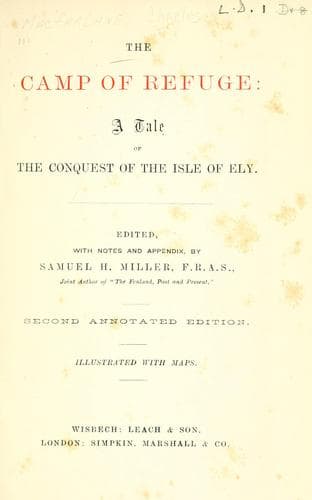
The Camp of Refuge: A Tale of the Conquest of the Isle of ElyMacFarlane, Charles
History
The Camp of Refuge: A Tale of the Conquest of the Isle of Ely
MacFarlane, Charles
Great Britain -- History -- Medieval period, 1066-1485 -- Fiction
The order was again given that all the gates of the abbey should be
kept closed; and during the whole of that day, or from the rising of
the sun to the setting thereof, no living soul was allowed either to
enter the house or to issue therefrom. So much did the traitors fear
lest their treasons and the wrongs they had done unto the good Lord
Abbat should become known to the good folk of Ely town, and through
them to the warriors in the Camp of Refuge. Some of the Saxon prelates
had gone forth for the Camp several days before, and had not yet
returned; but such as remained in the house (only a few sick and aged
men) were told that the Lord Abbat was sick, and could not be spoken
with, and that the doors and gates were kept closed in order that he
might not be disturbed. Nor was this all false. Thurstan’s wrath, and
then his grief and perturbations, had brought on a fever and ague and
he was lying on his bed in a very helpless and very hopeless state,
with none to help him or hear him, for the sub-prior had made fast the
door of the inner chamber, and the door of the chamber which led into
it; and the guard was stationed at a distance in the corridor.
CHAPTER XXIV.
THE DUNGEON.
It was just before sunset of the disastrous day which saw the
traitorous monks of Ely return from the castle at Cam-Bridge, that the
Lord of Brunn and his trusty sword-bearer arrived at Turbutsey[240]
(where the monks of old had landed the body of Saint Withburga) with
the corn and wine for the abbey; and also with the dead body of the
Salernitan, which they hoped to inter in the abbey church-yard.
Turbutsey had but few in-dwellers; and the poor hinds that were there
had heard nothing of the foul report of Lord Hereward’s death, which
had wrought such mischief in the abbey. Lord Hereward, eager to be at
his proper post in the Camp of Refuge, took the direct road, or path,
which led thereunto, carrying with him, for the comfort of secular
stomachs, only a few flagons of wine and a few measures of wheat, and
ordering Elfric to go up to the abbey with all the rest of the
provision, as soon as it should be all landed from the boats and
skerries. But, before the landing was finished, there came down some
gossips from the township of Ely, who reported with marvellous sad
faces, that the gates of the abbey had been closed ever since the
mid-day of yesterday; and that the whole house was as silent and sad as
a pest-house, on account, no doubt, of the death of the good Lord of
Brunn, the kind-hearted, open-handed lord, who had ever befriended the
Saxon poor! Upon hearing them talk in this fashion, the sword bearer
came up to the gossips, and told them that the Lord of Brunn was no
more dead than he was.
“Verily,” said the people, “the sad news came down to the township
yesterday before the hour of noon; and ever since then the abbey gates
and church gates have been closed, and the township hath been in tears.”
Public-domain text, read in full here on John Shaqi.
Reviews
Reviews
No reviews yet
Be the first to share your thoughts on this work.
Elsewhere in the archive
Join the Discussion
Join the discussion
Sign in to leave a comment or review.
Sign InorCreate an account