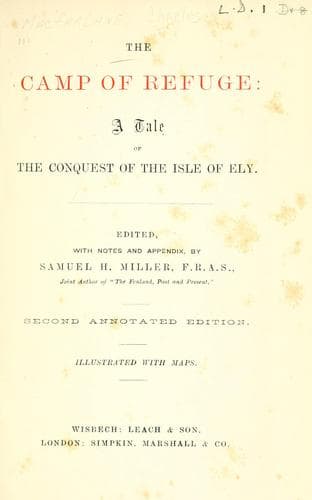
The Camp of Refuge: A Tale of the Conquest of the Isle of ElyMacFarlane, Charles
History
The Camp of Refuge: A Tale of the Conquest of the Isle of Ely
MacFarlane, Charles
Great Britain -- History -- Medieval period, 1066-1485 -- Fiction
which blessed his sleep, into scenes as bright as the chapel of Saint
Etheldreda in the abbey church, on the great day of the saint’s
festival, when a thousand waxen tapers are burning, and the whole air
is loaded with incense and with music. It was the sunshine of a good
conscience shining inwardly.
Now, while it fared thus with the captive below, much talk and
discussion took place among divers of the honest monks above; for,
notwithstanding the great care which had been taken to send away the
Ely folk, and to seize and gag Elfric as soon as he came within the
gate, the cry of the men of Ely, and the shout of the sword-bearer that
Lord Hereward had come back, and had brought much corn and wine, were
heard in almost every part of the house; and, upon hearing them, the
monks that were not of the faction grievously lamented what had been
done against the Lord Abbat, and in favour of the Normans, and very
clearly perceived that a trick had been put upon them in the report of
Lord Hereward’s death.
“I tell ye now, as I told ye then,” said Father Kynric, “that ye all
make too much account of your meat and drink, and are all too impatient
of temporary inconvenience. But what said the blessed Etheldreda? ‘The
fashion of this world passeth away; and that only is to be accounted
life which is purchased by submitting to temporal inconveniences.’”
“And tell me,” said that other good old Saxon monk, the Father Celred;
“tell me, oh my brethren, tell me how Saint Etheldreda fared when she
was in the flesh, and ruled this house as lady abbess?”
“Aye,” said good Father Elsin, “Saint Etheldreda never wore linen, but
only woollen; she never returned to her bed after matins, which were
then begun immediately after midnight; and, except on the great
festivals of the church, she ate only once a day, nor cared nor knew
whether her bread was white or brown.”
“Alack!” said Kenulph of Swaffham, a cloister-monk who had voted for
the wicked prior solely because the cellars and the granaries were
empty; “alack! man’s flesh is weak, and hunger is so strong! Saint
Etheldreda was a woman, and a delicate princess; but, an she had been
an upland man like me, and with such a sharp Saxon stomach as I have,
she never could have lived upon one meal a day!”
“That is to say,” quoth Father Cranewys, “if she had not been sustained
by permanent and wondrous miracle, for ye wis, Brother Kenulph, that
there be ladie saints in hagiology that have lived for octaves, and for
whole moons together, upon nothing but the scent of a rose. I wonder,
and would fain know, how much corn and wine the Lord of Brunn hath
brought with him.”
Public-domain text, read in full here on John Shaqi.
Reviews
Reviews
No reviews yet
Be the first to share your thoughts on this work.
Elsewhere in the archive
Join the Discussion
Join the discussion
Sign in to leave a comment or review.
Sign InorCreate an account