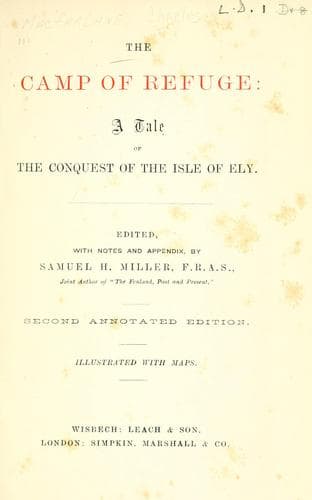
The Camp of Refuge: A Tale of the Conquest of the Isle of ElyMacFarlane, Charles
History
The Camp of Refuge: A Tale of the Conquest of the Isle of Ely
MacFarlane, Charles
Great Britain -- History -- Medieval period, 1066-1485 -- Fiction
“Fools!” shouted the Lord of Brunn, “these Normans will show ye no
mercy! There is no grace for ye but in your own swords!” And then the
Saxons took heart again, and rallying round Hereward, they soon charged
the foe, and fought them hand to hand. In their turn the Normans began
to yield, and to cry for quarter; but this band in the centre was
supported by another and another; and soon Duke William, and that
ungodly bishop, his brother, came back into the interior of the Camp,
with many knights and men-at-arms that had not yet tasted the sharpness
of the Saxon steel, and that were all fresh for the combat. Louder and
louder waxed the war-cry on either side, and terrible and strange
became the scene within the wide Camp; for the cattle, scared by the
loud noise, and by the clash and the glittering of arms, were running
wildly about the Camp in the midst of the combatants; and the fierce
bulls of the fens, lashing themselves into furor, and turning up the
soil with their horns, came careering down, and breaking through the
serried lines of the invaders; and many a Norman was made to feel that
his mail jacket was but a poor defence against the sharp horns of the
bull that pastured on the patrimony of Saint Etheldreda. Also rose
there to heaven a dreadful rugitus, or roaring, mixed with the loud
bewailing and the shrieks of timid herdsmen, and of women and children;
and the wives and children of the Saxons ran about the Camp, seeking
for a place of safety, and finding none. The Saxon warriors were now
falling fast, but the Normans fell also; and victory was still
doubtful, when loud shouts were heard, and another forest of lances was
seen coming down on the Camp from the south; and upon this, one entire
body of the Saxon host threw down their arms, and surrendered
themselves as prisoners.
Hereward, who was leaning upon his battle-axe, and wiping the sweat
from his brow, said to his sword-bearer, “This is a sad sight!”
“A sad sight and a shameful,” quoth Elfric; “but there are Saxons still
that are not craven; Here our lines be all unbroken.”
“And so will we yet fight on,” quoth Hereward.
But the Lord of Brunn had scarcely said the words when a number of
Saxon lords, old dwellers in the Camp of Refuge, and men that had
fought at Hastings, and in many a battle since, gathered round Lord
Hereward, and threw their swords and battle-axes and dinted shields
upon the ground, and told him that the fight was lost, and that (_de
communi concilio magnatum_), with the common advice and consent of the
magnates, they had all determined to surrender upon quarter, and take
the King’s peace.
Public-domain text, read in full here on John Shaqi.
Reviews
Reviews
No reviews yet
Be the first to share your thoughts on this work.
Elsewhere in the archive
Join the Discussion
Join the discussion
Sign in to leave a comment or review.
Sign InorCreate an account