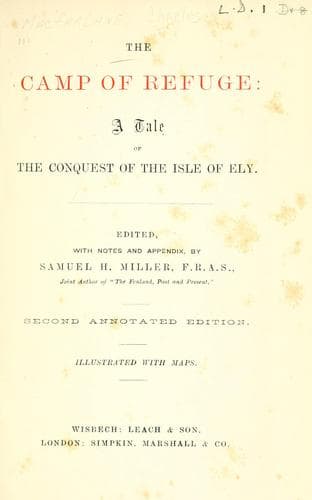
The Camp of Refuge: A Tale of the Conquest of the Isle of ElyMacFarlane, Charles
History
The Camp of Refuge: A Tale of the Conquest of the Isle of Ely
MacFarlane, Charles
Great Britain -- History -- Medieval period, 1066-1485 -- Fiction
Duke William was now waxing old and growing exceedingly fat, in sort
that he could not bestir himself as he had been used to do. At the same
time his sons, who had grown into man’s estate, had become very
undutiful, and even rebellious. Robert, his first-born, who was short
in his legs, but very lofty in spirit, claimed as his own the duchy of
Normandie and the county of Maine, alleging that the dominion of those
countries had been promised to him by his father, and that his father
ought to rest satisfied with the great kingdom of England. And although
William had told Robert that he would not throw off his clothes until
he went to bed—meaning thereby to say that he would give up none of
his principalities and powers until he went to his grave—that
impatient, furious young man showed that he would not wait and be
patient. The family of the Conqueror was a brotherhood of Cains.
Robert, less favoured by nature than they, thought that his father
always gave preference to his younger brothers William and Henry: and
being in France, in the little town of Aigle, William and Henry, after
playing at dice, as was the fashion with milites, made a great noise
and uproar, to the great disturbance of their elder brother; and when
Robert remonstrated with them from a courtyard beneath, they called him
Shorthose, and emptied a pitcher of water upon his head. Thereupon
Robert drew his sword and would have slain both his brothers; but being
prevented in that, he raised the standard of revolt against his own
father, and endeavoured to surprise the city and strong castle at
Rouen. Here, too, Robert failed of success, but he fled into Brittanie;
and he was now visibly supported not only by many Breton chiefs and by
the great Count of Anjou, but also by Philip the French king, who never
could stomach the power and greatness to which the son of the harlot of
Falaise had attained. Now, while all this mischief was brewing, Duke
William felt that there were many of the barons in Normandie in whom he
could put no manner of trust, and he well knew that too many of the
great Normans settled in England were unsteady in their allegiance to
him. In this state of things it behoved him more than ever to insure
tranquillity in England before he should again cross the seas, and to
endeavour to secure the goodwill of the Saxon people, who were
gradually becoming accustomed to his rule, and who had but so recently
shown how valorously they could fight for him when he put his trust in
them. And therefore had he somewhat relaxed the rigour of his
government towards the English people, and had made promise to many
native nobles that he would govern the country according to the good
laws of Edward the Confessor. Now some of these English nobles were
closely allied by blood with the Ladie Lucia, and consequently with the
Ladie Alftrude; and was not the Ladie Lucia the wife of Duke William’s
own nephew, Ivo Taille-Bois? And was not the Ladie Alftrude wife unto
Public-domain text, read in full here on John Shaqi.
Reviews
Reviews
No reviews yet
Be the first to share your thoughts on this work.
Elsewhere in the archive
Join the Discussion
Join the discussion
Sign in to leave a comment or review.
Sign InorCreate an account