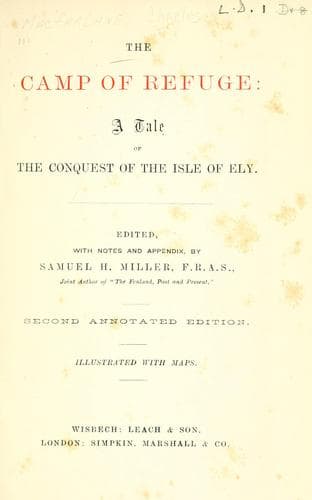
The Camp of Refuge: A Tale of the Conquest of the Isle of ElyMacFarlane, Charles
History
The Camp of Refuge: A Tale of the Conquest of the Isle of Ely
MacFarlane, Charles
Great Britain -- History -- Medieval period, 1066-1485 -- Fiction
It was under one of the fiercest and loudest tempests that ever blew
from the sky of winter, and upon one of the roughest seas that ever
rolled into the Wash, that five barks, which seemed all to be deeply
laden and crowded with men, drove past the shoal called the
Dreadful,[111] and made for that other shoal called the Inner Dousing.
The sun, which had not been visible the whole day, now showed itself
like a ball of fire as it sank in the west behind the flats and fens of
Lincolnshire; and when the sun was down the fury of the tempest seemed
to increase. When they had neared the Inner Dousing, four of the barks
took in all their sail and lay-to as best they could in the trough of
the sea; but the fifth bark stood gallantly in for the Wash, with
nearly all her sails up. Swift as it bounded over the waves, it was
dark night before the foremost bark reached the little cape where
stands the chapel of our Ladie.[112] Here the bark showed three lights
at her mast-head, and then three lights over her prow, and then three
over her stern. Quickly as might be, these lights from on board the
fifth and foremost bark were answered by three times three of lights on
the belfry of Our Ladie’s chapel; and had it not been for the roaring
of the winds and the loud dashing of the sea on the resounding shore,
those on land by Our Ladie’s chapel might have heard a three times
three of hearty cheers from those on shipboard, and those on the ship
might have heard every cheer given back with interest and increase by
the crowd of true Saxons that stood by the chapel. The bark next showed
at her masthead a broad blue light, such as had never been seen before
in these parts; and presently from the lee side of the Inner Dousing
four other bright blue lights gleamed across the black sky; and having
in this wise answered signal, the four barks followed in the track of
the fifth and came up with it off Our Ladie’s chapel. Still keeping a
little in advance, like the pilot and admiral of the little fleet, the
bark that had first reached the coast glided into Lynn Deeps; and as it
advanced towards the mouth of the Ouse, signal-lights or piloting
lights rose at every homestead and hamlet, from Kitcham[113] to
Stone’s-end, from Stone’s-end to Castle Rising, and from Castle Rising
to the good town of Lynn. And besides these stationary lights, there
were other torches running along the shore close above the line of sea
foam. And much was all this friendly care needed, the deeps being
narrow and winding and the shoals and sand-banks showing themselves on
every side, and the wind still blowing a hurricane, and the masts of
the barks bending and cracking even under the little sail that they now
carried. On this eastern side of the Wash few could have slept, or have
tarried in their homes this night; for when—near upon midnight, and as
the monks of Lynn were preparing to say matins in the chapel of Saint
Nicholas—the five barks swirled safely into the deep and easy bed of
Public-domain text, read in full here on John Shaqi.
Reviews
Reviews
No reviews yet
Be the first to share your thoughts on this work.
Elsewhere in the archive
Join the Discussion
Join the discussion
Sign in to leave a comment or review.
Sign InorCreate an account