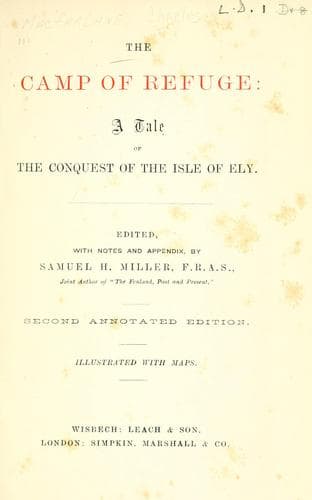
The Camp of Refuge: A Tale of the Conquest of the Isle of ElyMacFarlane, Charles
History
The Camp of Refuge: A Tale of the Conquest of the Isle of Ely
MacFarlane, Charles
Great Britain -- History -- Medieval period, 1066-1485 -- Fiction
the Ouse, and came up to the prior’s wharf, and let go their anchors,
and threw their stoutest cordage ashore, to the end that the mariners
there might make them fast, and so give a double security against wind
and tide, the wharf and all the river bank was covered with men, women,
and children, and the houses in the town behind the river bank were
nearly all lighted up, as if it had been Midsummer’s eve, instead of
being the penultimate night[114] of the Novena of Christmas. It was not
difficult to make out that the foremost of the barks and one other
belonged to Lynn, inasmuch as the Lynn folk leaped on board of them as
soon as they were made fast at the wharf, calling upon their town
fellows, their brothers or sons, and hugging them _more Saxonico_[115]
when they found them out on the crowded decks. The other barks were of
foreign structure, and the mariners seemed to be all foreigners; but
the many passengers in each of them were all Englishmen, and _landsmen_
besides; for they had all been very sea-sick, and were now very
impatient to get their feet upon dry land.
The first that landed from the foremost bark was a tall, robust, and
handsome man, dressed as Saxon noblemen and warriors were wont to dress
before the incoming of the ill fashions of Normandie.
He carried in his right hand a long straight and broad sword, the blade
of which was curiously sheathed, and the hilt of which formed a cross.
When he had crossed the plankings of the wharf, and reached the solid
ground, he knelt on one knee and kissed the cross of his sword; and
then throwing himself prone upon the earth, and casting wide his arms
as though he would embrace it and hug it, he kissed the insensate soil,
and thanked his God and every saint in the Saxon calendar for that he
had been restored to the land which gave him birth, and which held the
dust and bones of his fathers. Some who had seen him in former days on
the Spalding side of the Wash, and some who had been apprised of his
coming, began instantly to shout, “It is he!—it is Lord Hereward of
Brunn! It is Hereward the Saxon! It is the Lord of Brunn, come to get
back his own and to help us to drive out the Normans.” The shouts were
taken up on every side, mariners and landsmen, foreigners and home-born
fensmen, and women and children, crying, “It is Hereward the Saxon!
Long live the young Lord of Brunn, who will never shut his hall-door in
the face of a poor Englishman, nor turn his back on a Frenchman!” Some
hemmed him in, and kissed his hands, and the sheath of his long
straight sword, and the skirts of his mantle, and the very sandals on
his feet; while others held their glaring torches close over his head,
that they might see him and show him to their mates. It was one Nan of
Lynn, and a well-famed and well-spoken woman, that said, as she looked
upon the Lord Hereward, “We Englishwomen of the fens will beat the
men-at-arms from Normandie, an we be but led by such a captain as this;
Public-domain text, read in full here on John Shaqi.
Reviews
Reviews
No reviews yet
Be the first to share your thoughts on this work.
Elsewhere in the archive
Join the Discussion
Join the discussion
Sign in to leave a comment or review.
Sign InorCreate an account