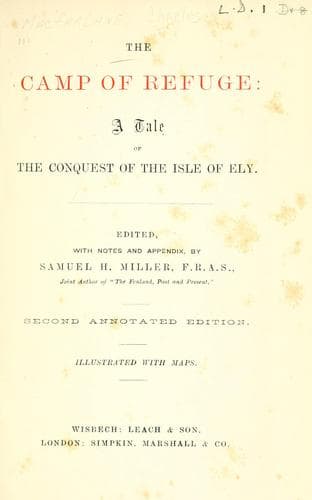
The Camp of Refuge: A Tale of the Conquest of the Isle of ElyMacFarlane, Charles
History
The Camp of Refuge: A Tale of the Conquest of the Isle of Ely
MacFarlane, Charles
Great Britain -- History -- Medieval period, 1066-1485 -- Fiction
But the prior and the sacrist and divers others continued to make a
great outcry about their goods, their holy-books, their altar vases,
their beds and their bed-clothes; and as this moved Lord Hereward’s
ire, he said to his merry men that they must turn them out; and the
merry men all did turn them out by pulling them before and kicking them
behind: and in this manner the unlettered and unholy crew that Ivo
Taille-Bois had thrust into the succursal cell of Spalding were lugged
and driven on shipboard, and there they were made fast under the
hatches. As soon as they were all cleared out of the convent, Lord
Hereward bade his Saxons put more fuel on the fire, and bring up more
wine, and likewise see what might be in the buttery. The brother of
Wybert the wright knew the way well both to cellar and buttery; and
finding both well filled, he soon re-appeared with wine and viands
enough. And so Hereward and his men warmed themselves by the blazing
fire, and ate and drank most merrily and abundantly: and when all had
their fill, and all had drunk a deep health to Hereward the liberator,
they went into the monk’s snug cells, and so fast to sleep.
On the morrow morning they rose betimes. So featly had the thing been
done over night, that none knew it but those who had been present. The
good folk that yet remained in Spalding town, though so close at hand,
had heard nothing of the matter. Hereward now summoned them to the
house; but having his reasons for wishing not to be known at this
present, he deputed one of his men to hold a conference with them, and
to tell the few good men of Spalding that the hour of deliverance was
at hand, that their false monks had been driven away, and that Father
Adhelm and their true monks would soon return: whereat the Spalding
folk heartily rejoiced. In the present state of the road, or rather of
the waters, there was no fear of any Norman force approaching the
succursal cell. Therefore Lord Hereward ordered that much of his
munition of war should be landed and deposited in the convent: and
leaving therein all his armed men with Girolamo of Salerno, he embarked
alone in the lightest of his barks, and went up the river as far as the
point that was nearest to Brunn. There, leaving the bark and all the
sailors, and taking with him nought but his sword and his fen-staff,
and covering himself with an old and tattered seaman’s coat, he landed
and struck across the fens, and walked, waded, leaped, and swam, until
he came within sight of his own old manor-house and the little township
of Brunn.[124] It was eventide, and the blue smoke was rising from the
manor-house and from the town, as peacefully as in the most peaceful
days. Hereward stopped and looked upon the tranquil scene, as he had
done so many times before at the same hour in the days of his youth,
when returning homeward from some visit, or from some fowling in the
fens; and as he looked, all that had since passed became as a dream;
Public-domain text, read in full here on John Shaqi.
Reviews
Reviews
No reviews yet
Be the first to share your thoughts on this work.
Elsewhere in the archive
Join the Discussion
Join the discussion
Sign in to leave a comment or review.
Sign InorCreate an account