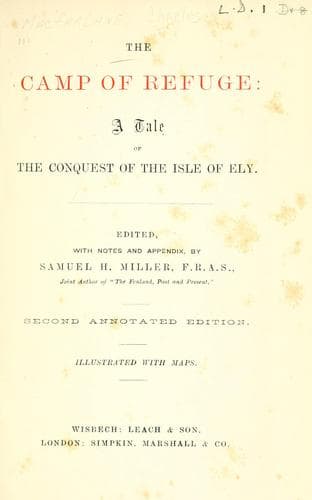
The Camp of Refuge: A Tale of the Conquest of the Isle of ElyMacFarlane, Charles
History
The Camp of Refuge: A Tale of the Conquest of the Isle of Ely
MacFarlane, Charles
Great Britain -- History -- Medieval period, 1066-1485 -- Fiction
And a busy night it was; for lo! in the morning, when Raoul the Norman
knight awoke from the deep sleep which had followed his heavy
overnight’s carouse, and looked forth from his chamber in the tower
over the gateway of the manor-house, he saw what seemed another and a
taller tower on the opposite side of the moat; and what seemed a bridge
of boats laid across the moat; and in the tower were archers with their
bows bent, and men-at-arms with swords and battle-axes. Raoul rubbed
his eyes, and still seeing the same sight, thought it all magic or a
dream. But there was more magic than this, for when he called up his
sleepy household, and his careless and over-confident men-at-arms, and
went round the house, he saw another bridge of boats leading to the
postern-gate at the back of the house, and beyond that bridge he saw a
catapult with a score of armed men standing by it. But look where he
would, there were armed men; the manor-house was surrounded, and
surrounded in such fashion that there could be no egress from it, and
small hope of defending it. The despairing Norman knight, therefore,
went back to his tower over the gateway, and called a parley.
“What would ye, O Saxons?” said Raoul; “know ye not that ye are
breaking the king’s peace? Who is your leader, and what wants he?”
“I am their leader and lord,” quoth Hereward, speaking from that
marvellous wooden tower which Girolamo had caused to be raised; “I am
their leader and the Lord of Brunn, and all that I want is to get
possession of my house and lands. So come forth, Norman, and fear not!
Thou and thy men shall have quarter and kindly treatment. But if ye
seek to resist, or let fly so much as one arrow upon these my good
people, by all the saints of old England I will hang ye all on one
gibbet.”
“What shall we do in this strait?” said Raoul to his seneschal.
“Take terms and surrender,” quoth the seneschal; “for the house cannot
be defended against the host that is come against it, and against the
engines of war that are raised against it. Three butts of that catapult
would shiver the postern gate; that tower in front commands the
battlements; the bridges of boats will give access to every part of the
walls. This could not be done in one short night, except by magic; but
magic is not to be withstood by sinful men-at-arms, and our chaplain is
gone to feast with the monks of Crowland. Moreover, oh Raoul, we have
consumed nearly all our provisions in our own feastings, and so should
starve in a day or two if we could hold out so long—but that is
impossible.”
“But,” said Raoul, “be there not some twenty or thirty Norman lances no
farther off than in the town of Stamford?”[128]
“But they cannot cross the wide watery fens; and if they were here they
could not charge among these accursed bogs.”
“’Tis all too true,” quoth Raoul, “and therefore must we surrender.”
Public-domain text, read in full here on John Shaqi.
Reviews
Reviews
No reviews yet
Be the first to share your thoughts on this work.
Elsewhere in the archive
Join the Discussion
Join the discussion
Sign in to leave a comment or review.
Sign InorCreate an account