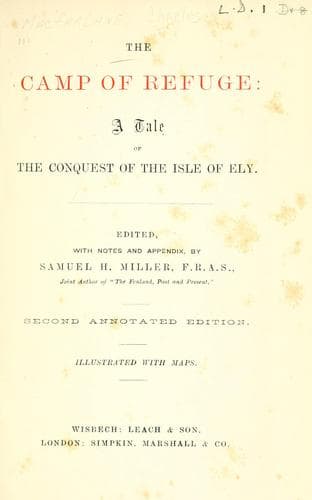
The Camp of Refuge: A Tale of the Conquest of the Isle of ElyMacFarlane, Charles
History
The Camp of Refuge: A Tale of the Conquest of the Isle of Ely
MacFarlane, Charles
Great Britain -- History -- Medieval period, 1066-1485 -- Fiction
“Never doubt it,” quoth Elfric: “the Norman spoilers and oppressors are
gone to a man, and as naked as they came. I, the humble friend and
follower of my Lord Hereward the liberator, am here to dispense
hospitality to-night; your own Lord Abbat will be here in a few days;
and the dread of our demons of the fens and Crowland devils will make
the invaders run from all the fen country. So much good could not have
come out of evil; if the means employed had been unlawful or in any way
sinful, we should have failed, and never have met with such easy and
complete success.”
“Nevertheless,” continued Gaffer, “the things which I have seen fill me
with doubt and amaze. Whoever saw the like before? Fire burning upon
the top of water, flames not to be quenched by water from below nor by
water from above! Smoke and flames not of their natural colours, but
blue, and green, and scarlet, and bright yellow! and the light from
these flames so dazzling and so ghastly! In truth I wot not how this
can be done by mortal man!”
“Nor wot I,” said Elfric; “but this I know full well, that there was no
magic or sortilege in the preparation, and that the stranger is as good
and devout a Christian as any that dwells in the land. Many are the
things which I have seen done by the hand of man that I cannot
understand; but am I therefore to think that the evil one hath a finger
in them? I have carried on my back, and have handled with mine own
hands, the liquids and the substances which have been used, and yet
have felt neither cramp nor any other ache. And plain homely things
those substances and liquids do appear to be—the quietest and dullest
trash until mixed together and compounded. Girolamo, who hath studied
in the schools in foreign parts, even as our young clerks studied at
Cam-Bridge before the detestable Normans came and built their donjon
there, calls this art of compounding by the name of Chemeia, or Chimia,
and he says that things much more wondrous are to be done by it.
Further, he says, that his own proficiency has been acquired by long
fasting and diligent study, by prayers to heaven and votive offerings
to the saints. Methinks it were better to give God credit for these
inventions and combinations, and for the wit and ingenuity of man, than
to be always attributing them to the devil, as our uninformed clowns
do. [But these last words the ex-novice spoke under his breath.] And
this also do I know—the stranger sprinkled his powders with holy
water, and prayed the prayers of our church all the while he was doing
his preparations.”
“But what makes him look so grim and black, and so wild about the
eyes,” said the old cook.
Public-domain text, read in full here on John Shaqi.
Reviews
Reviews
No reviews yet
Be the first to share your thoughts on this work.
Elsewhere in the archive
Join the Discussion
Join the discussion
Sign in to leave a comment or review.
Sign InorCreate an account