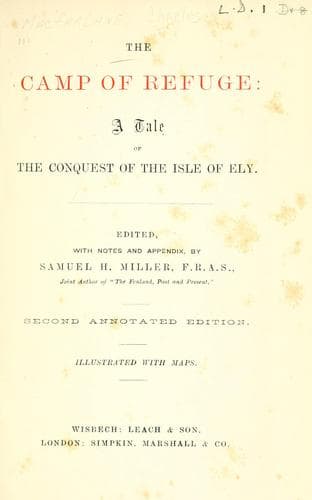
The Camp of Refuge: A Tale of the Conquest of the Isle of ElyMacFarlane, Charles
History
The Camp of Refuge: A Tale of the Conquest of the Isle of Ely
MacFarlane, Charles
Great Britain -- History -- Medieval period, 1066-1485 -- Fiction
Ivo Taille-Bois, whom some did call the devil of the fens, was not in
the manor-house of the Ladie Lucia, near unto Spalding, when Hereward
first came to claim his own, and to turn out his false monks. Being
weary with living among bogs and marshes, and having occasion to
consult with the Norman vicomte who held command at Stamford, Ivo had
gone to that town, some few days before the feast of the Nativity, and
had carried with him his Saxon wife and her infant child, leaving none
in the moated and battlemented house save a few servants, and some ten
or twelve armed Normans. The house was strong and difficult of access;
but if it had not been for the respect due to the Lady Lucia, the
kinswoman of his own Ladie Alftrude, Hereward, on his gaining
possession of Spalding, would have made a rough attempt upon it: and
such was the temper of the Saxons within the house, that doubtlessly
they would have played into his hands. For several days the Normans
remained wholly ignorant of the great things which had been done in the
succursal cell, at Brunn and at Crowland, for they could not venture
outside the walls of the manor-house, and even if there had been no
danger in their so doing, the inundated state of the country, and the
cold wintry weather, offered few temptations to rambling. At length the
passing of many skerries across the fens, and the frequent passage of
larger boats, crowded with people, on the broad and not distant
Welland, and the triumphant shouts that were occasionally heard from
the banks of the river, caused the men-at-arms to suspect that some
insurrection was a-foot. They thanked their stars that the moat was so
broad, the house so strong, and the store-house so well stored, and
they went on sleeping like dormice, or like squirrels, in the topmost
hollow of an oak, whose root is deep under the wintry waters. They
could not trust any Saxon messenger to Stamford; and therefore it was
not from his garrison in the manor-house, but directly from Alain of
Beauvais and others of that unholy crew, that the fierce Ivo learned
all that had happened upon or round about his wife’s domains. Some of
the herd were seized with fever and delirium—the effects of fear and
fatigue and wet clothes—and they did not recover their senses for many
a week; but Alain and such of them as could talk and reason, related
all the horrible circumstances of their expulsion and flight, of the
onset of the devils of Crowland, and of the close and self-evident
league existing between Beelzebub and the Saxons. All this was horrible
to hear; but Alain of Beauvais pronounced a name which was more
horrible or odious to Ivo Taille-Bois than that of Lucifer
himself:—this was the name of Hereward the Saxon—of Hereward the Lord
of Brunn, which the men of Crowland town had shouted in their ears as
the Norman monks were flying along the causeway. Partly through the
tattle of some serving-women, and more through the confidence of his
Public-domain text, read in full here on John Shaqi.
Reviews
Reviews
No reviews yet
Be the first to share your thoughts on this work.
Elsewhere in the archive
Join the Discussion
Join the discussion
Sign in to leave a comment or review.
Sign InorCreate an account