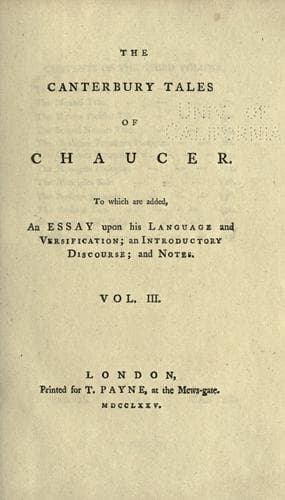
The Canterbury Tales, and Other PoemsChaucer, Geoffrey
ReligionChristian
The Canterbury Tales, and Other Poems
Chaucer, Geoffrey
Chaucer, Geoffrey, -1400; Christian pilgrims and pilgrimages -- Poetry; English poetry -- Middle English, 1100-1500
Alein spake first; “All hail, Simon, in faith,
How fares thy faire daughter, and thy wife.”
“Alein, welcome,” quoth Simkin, “by my life,
And John also: how now, what do ye here?”
“By God, Simon,” quoth John, “need has no peer*. *equal
Him serve himself behoves that has no swain*, *servant
Or else he is a fool, as clerkes sayn.
Our manciple I hope* he will be dead, *expect
So workes aye the wanges* in his head: *cheek-teeth <8>
And therefore is I come, and eke Alein,
To grind our corn and carry it home again:
I pray you speed us hence as well ye may.”
“It shall be done,” quoth Simkin, “by my fay.
What will ye do while that it is in hand?”
“By God, right by the hopper will I stand,”
Quoth John, “and see how that the corn goes in.
Yet saw I never, by my father’s kin,
How that the hopper wagges to and fro.”
Alein answered, “John, and wilt thou so?
Then will I be beneathe, by my crown,
And see how that the meale falls adown
Into the trough, that shall be my disport*: *amusement
For, John, in faith I may be of your sort;
I is as ill a miller as is ye.”
This miller smiled at their nicety*, *simplicity
And thought, “All this is done but for a wile.
They weenen* that no man may them beguile, *think
But by my thrift yet shall I blear their eye,<9>
For all the sleight in their philosophy.
The more *quainte knackes* that they make, *odd little tricks*
The more will I steal when that I take.
Instead of flour yet will I give them bren*. *bran
The greatest clerks are not the wisest men,
As whilom to the wolf thus spake the mare: <10>
Of all their art ne count I not a tare.”
Out at the door he went full privily,
When that he saw his time, softely.
He looked up and down, until he found
The clerkes’ horse, there as he stood y-bound
Behind the mill, under a levesell:* *arbour<11>
And to the horse he went him fair and well,
And stripped off the bridle right anon.
And when the horse was loose, he gan to gon
Toward the fen, where wilde mares run,
Forth, with “Wehee!” through thick and eke through thin.
This miller went again, no word he said,
But did his note*, and with these clerkes play’d, *business <12>
Till that their corn was fair and well y-ground.
And when the meal was sacked and y-bound,
Then John went out, and found his horse away,
And gan to cry, “Harow, and well-away!
Our horse is lost: Alein, for Godde’s bones,
Step on thy feet; come off, man, all at once:
Alas! our warden has his palfrey lorn.*” *lost
This Alein all forgot, both meal and corn;
All was out of his mind his husbandry*. *careful watch over
“What, which way is he gone?” he gan to cry. the corn*
The wife came leaping inward at a renne*, *run
She said; “Alas! your horse went to the fen
Public-domain text, read in full here on John Shaqi.
Reviews
Reviews
No reviews yet
Be the first to share your thoughts on this work.
Elsewhere in the archive
Join the Discussion
Join the discussion
Sign in to leave a comment or review.
Sign InorCreate an account