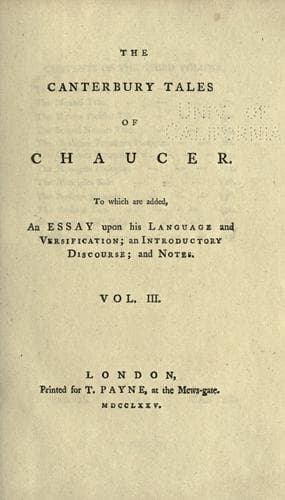
The Canterbury Tales, and Other PoemsChaucer, Geoffrey
ReligionChristian
The Canterbury Tales, and Other Poems
Chaucer, Geoffrey
Chaucer, Geoffrey, -1400; Christian pilgrims and pilgrimages -- Poetry; English poetry -- Middle English, 1100-1500
This King Alla, when he his time sey,* *saw
With his Constance, his holy wife so sweet,
To England are they come the righte way,
Where they did live in joy and in quiet.
But little while it lasted, I you hete,* *promise
Joy of this world for time will not abide,
From day to night it changeth as the tide.
Who liv’d ever in such delight one day,
That him not moved either conscience,
Or ire, or talent, or *some kind affray,* *some kind of disturbance*
Envy, or pride, or passion, or offence?
I say but for this ende this sentence,* *judgment, opinion*
That little while in joy or in pleasance
Lasted the bliss of Alla with Constance.
For death, that takes of high and low his rent,
When passed was a year, even as I guess,
Out of this world this King Alla he hent,* *snatched
For whom Constance had full great heaviness.
Now let us pray that God his soule bless:
And Dame Constance, finally to say,
Toward the town of Rome went her way.
To Rome is come this holy creature,
And findeth there her friendes whole and sound:
Now is she scaped all her aventure:
And when that she her father hath y-found,
Down on her knees falleth she to ground,
Weeping for tenderness in hearte blithe
She herieth* God an hundred thousand sithe.** *praises **times
In virtue and in holy almes-deed
They liven all, and ne’er asunder wend;
Till death departeth them, this life they lead:
And fare now well, my tale is at an end
Now Jesus Christ, that of his might may send
Joy after woe, govern us in his grace
And keep us alle that be in this place.
Notes to the Man of Law’s Tale
1. This tale is believed by Tyrwhitt to have been taken, with no
material change, from the “Confessio Amantis” of John Gower,
who was contemporary with Chaucer, though somewhat his
senior. In the prologue, the references to the stories of Canace,
and of Apollonius Tyrius, seem to be an attack on Gower, who
had given these tales in his book; whence Tyrwhitt concludes
that the friendship between the two poets suffered some
interruption in the latter part of their lives. Gower was not the
inventor of the story, which he found in old French romances,
and it is not improbable that Chaucer may have gone to the
same source as Gower, though the latter undoubtedly led the
way.
(Transcriber’s note: later commentators have identified the
introduction describing the sorrows of poverty, along with the
other moralising interludes in the tale, as translated from “De
Contemptu Mundi” (“On the contempt of the world”) by Pope
Innocent.)
2. Transcriber’ note: This refers to the game of hazard, a dice
game like craps, in which two (“ambes ace”) won, and eleven
(“six-cinque”) lost.
3. Purpose: discourse, tale: French “propos”.
4. “Peace” rhymed with “lese” and “chese”, the old forms of
“lose” and “choose”.
Public-domain text, read in full here on John Shaqi.
Reviews
Reviews
No reviews yet
Be the first to share your thoughts on this work.
Elsewhere in the archive
Join the Discussion
Join the discussion
Sign in to leave a comment or review.
Sign InorCreate an account