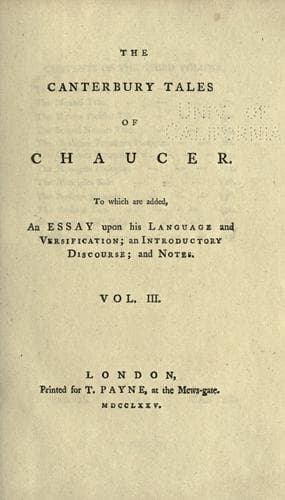
The Canterbury Tales, and Other PoemsChaucer, Geoffrey
ReligionChristian
The Canterbury Tales, and Other Poems
Chaucer, Geoffrey
Chaucer, Geoffrey, -1400; Christian pilgrims and pilgrimages -- Poetry; English poetry -- Middle English, 1100-1500
Thou say’st, we wives will our vices hide,
Till we be fast,* and then we will them shew. *wedded
Well may that be a proverb of a shrew.* *ill-tempered wretch
Thou say’st, that oxen, asses, horses, hounds,
They be *assayed at diverse stounds,* *tested at various
Basons and lavers, ere that men them buy, seasons
Spoones, stooles, and all such husbandry,
And so be pots, and clothes, and array,* *raiment
But folk of wives make none assay,
Till they be wedded, — olde dotard shrew! —
And then, say’st thou, we will our vices shew.
Thou say’st also, that it displeaseth me,
But if * that thou wilt praise my beauty, *unless
And but* thou pore alway upon my face, *unless
And call me faire dame in every place;
And but* thou make a feast on thilke** day *unless **that
That I was born, and make me fresh and gay;
And but thou do to my norice* honour, *nurse <12>
And to my chamberere* within my bow’r, *chamber-maid
And to my father’s folk, and mine allies;* *relations
Thus sayest thou, old barrel full of lies.
And yet also of our prentice Jenkin,
For his crisp hair, shining as gold so fine,
And for he squireth me both up and down,
Yet hast thou caught a false suspicioun:
I will him not, though thou wert dead to-morrow.
But tell me this, why hidest thou, *with sorrow,* *sorrow on thee!*
The keyes of thy chest away from me?
It is my good* as well as thine, pardie. *property
What, think’st to make an idiot of our dame?
Now, by that lord that called is Saint Jame,
Thou shalt not both, although that thou wert wood,* *furious
Be master of my body, and my good,* *property
The one thou shalt forego, maugre* thine eyen. *in spite of
What helpeth it of me t’inquire and spyen?
I trow thou wouldest lock me in thy chest.
Thou shouldest say, ‘Fair wife, go where thee lest;
Take your disport; I will believe no tales;
I know you for a true wife, Dame Ales.’* *Alice
We love no man, that taketh keep* or charge *care
Where that we go; we will be at our large.
Of alle men most blessed may he be,
The wise astrologer Dan* Ptolemy, *Lord
That saith this proverb in his Almagest:<13>
‘Of alle men his wisdom is highest,
That recketh not who hath the world in hand.
By this proverb thou shalt well understand,
Have thou enough, what thar* thee reck or care *needs, behoves
How merrily that other folkes fare?
For certes, olde dotard, by your leave,
Ye shall have [pleasure] <14> right enough at eve.
He is too great a niggard that will werne* *forbid
A man to light a candle at his lantern;
He shall have never the less light, pardie.
Public-domain text, read in full here on John Shaqi.
Reviews
Reviews
No reviews yet
Be the first to share your thoughts on this work.
Elsewhere in the archive
Join the Discussion
Join the discussion
Sign in to leave a comment or review.
Sign InorCreate an account