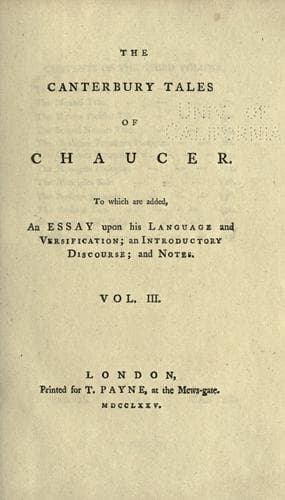
The Canterbury Tales, and Other PoemsChaucer, Geoffrey
ReligionChristian
The Canterbury Tales, and Other Poems
Chaucer, Geoffrey
Chaucer, Geoffrey, -1400; Christian pilgrims and pilgrimages -- Poetry; English poetry -- Middle English, 1100-1500
There is no capel* drawing in a cart, *horse
That might have let a fart of such a soun’.
The friar up start, as doth a wood* lioun: *fierce
“Ah, false churl,” quoth he, “for Godde’s bones,
This hast thou in despite done for the nones:* *on purpose
Thou shalt abie* this fart, if that I may.” *suffer for
His meinie,* which that heard of this affray, *servants
Came leaping in, and chased out the frere,
And forth he went with a full angry cheer* *countenance
And fetch’d his fellow, there as lay his store:
He looked as it were a wilde boar,
And grounde with his teeth, so was he wroth.
A sturdy pace down to the court he go’th,
Where as there wonn’d* a man of great honour, *dwelt
To whom that he was always confessour:
This worthy man was lord of that village.
This friar came, as he were in a rage,
Where as this lord sat eating at his board:
Unnethes* might the friar speak one word, *with difficulty
Till at the last he saide, “God you see.”* *save
This lord gan look, and said, “Ben’dicite!
What? Friar John, what manner world is this?
I see well that there something is amiss;
Ye look as though the wood were full of thieves.
Sit down anon, and tell me what your grieve* is, *grievance, grief
And it shall be amended, if I may.”
“I have,” quoth he, “had a despite to-day,
God *yielde you,* adown in your village, *reward you
That in this world is none so poor a page,
That would not have abominatioun
Of that I have received in your town:
And yet ne grieveth me nothing so sore,
As that the olde churl, with lockes hoar,
Blasphemed hath our holy convent eke.”
“Now, master,” quoth this lord, “I you beseek” —
“No master, Sir,” quoth he, “but servitour,
Though I have had in schoole that honour. <24>
God liketh not, that men us Rabbi call
Neither in market, nor in your large hall.”
*“No force,”* quoth he; “but tell me all your grief.” *no matter*
Sir,” quoth this friar, “an odious mischief
This day betid* is to mine order and me, *befallen
And so par consequence to each degree
Of holy churche, God amend it soon.”
“Sir,” quoth the lord, “ye know what is to doon:* *do
*Distemp’r you not,* ye be my confessour. *be not impatient*
Ye be the salt of th’ earth, and the savour;
For Godde’s love your patience now hold;
Tell me your grief.” And he anon him told
As ye have heard before, ye know well what.
The lady of the house aye stiller sat,
Till she had hearde what the friar said,
“Hey, Godde’s mother;” quoth she, “blissful maid,
Is there ought elles? tell me faithfully.”
“Madame,” quoth he, “how thinketh you thereby?”
“How thinketh me?” quoth she; “so God me speed,
I say, a churl hath done a churlish deed,
What should I say? God let him never the;* *thrive
His sicke head is full of vanity;
Public-domain text, read in full here on John Shaqi.
Reviews
Reviews
No reviews yet
Be the first to share your thoughts on this work.
Elsewhere in the archive
Join the Discussion
Join the discussion
Sign in to leave a comment or review.
Sign InorCreate an account