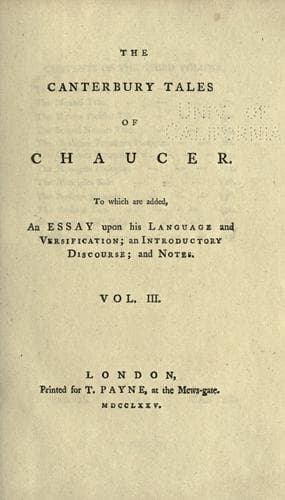
The Canterbury Tales, and Other PoemsChaucer, Geoffrey
ReligionChristian
The Canterbury Tales, and Other Poems
Chaucer, Geoffrey
Chaucer, Geoffrey, -1400; Christian pilgrims and pilgrimages -- Poetry; English poetry -- Middle English, 1100-1500
Not far from thilke* palace honourable, *that
Where as this marquis shope* his marriage, *prepared; resolved on
There stood a thorp,* of sighte delectable, *hamlet
In which the poore folk of that village
Hadde their beastes and their harbourage,* *dwelling
And of their labour took their sustenance,
After the earthe gave them abundance.
Among this poore folk there dwelt a man
Which that was holden poorest of them all;
But highe God sometimes sende can
His grace unto a little ox’s stall;
Janicola men of that thorp him call.
A daughter had he, fair enough to sight,
And Griseldis this younge maiden hight.
But for to speak of virtuous beauty,
Then was she one the fairest under sun:
Full poorely y-foster’d up was she;
No *likerous lust* was in her heart y-run; *luxurious pleasure*
Well ofter of the well than of the tun
She drank, <4> and, for* she woulde virtue please *because
She knew well labour, but no idle ease.
But though this maiden tender were of age;
Yet in the breast of her virginity
There was inclos’d a *sad and ripe corage;* *steadfast and mature
And in great reverence and charity spirit*
Her olde poore father foster’d she.
A few sheep, spinning, on the field she kept,
She woulde not be idle till she slept.
And when she homeward came, she would bring
Wortes,* and other herbes, times oft, *plants, cabbages
The which she shred and seeth’d for her living,
And made her bed full hard, and nothing soft:
And aye she kept her father’s life on loft* *up, aloft
With ev’ry obeisance and diligence,
That child may do to father’s reverence.
Upon Griselda, this poor creature,
Full often sithes* this marquis set his eye, *times
As he on hunting rode, paraventure:* *by chance
And when it fell that he might her espy,
He not with wanton looking of folly
His eyen cast on her, but in sad* wise *serious
Upon her cheer* he would him oft advise;** *countenance **consider
Commending in his heart her womanhead,
And eke her virtue, passing any wight
Of so young age, as well in cheer as deed.
For though the people have no great insight
In virtue, he considered full right
Her bounte,* and disposed that he would *goodness
Wed only her, if ever wed he should.
The day of wedding came, but no wight can
Telle what woman that it shoulde be;
For which marvail wonder’d many a man,
And saide, when they were in privity,
“Will not our lord yet leave his vanity?
Will he not wed? Alas, alas the while!
Why will he thus himself and us beguile?”
Public-domain text, read in full here on John Shaqi.
Reviews
Reviews
No reviews yet
Be the first to share your thoughts on this work.
Elsewhere in the archive
Join the Discussion
Join the discussion
Sign in to leave a comment or review.
Sign InorCreate an account