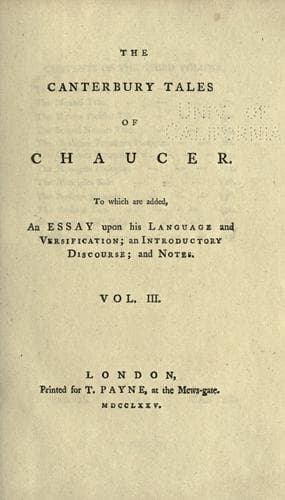
The Canterbury Tales, and Other PoemsChaucer, Geoffrey
ReligionChristian
The Canterbury Tales, and Other Poems
Chaucer, Geoffrey
Chaucer, Geoffrey, -1400; Christian pilgrims and pilgrimages -- Poetry; English poetry -- Middle English, 1100-1500
Though that her husband absent were or non,* *not
If gentlemen or other of that country,
Were wroth,* she woulde bringe them at one, *at feud
So wise and ripe wordes hadde she,
And judgement of so great equity,
That she from heaven sent was, as men wend,* *weened, imagined
People to save, and every wrong t’amend
Not longe time after that this Griseld’
Was wedded, she a daughter had y-bore;
All she had lever* borne a knave** child, *rather **boy
Glad was the marquis and his folk therefore;
For, though a maiden child came all before,
She may unto a knave child attain
By likelihood, since she is not barren.
*Pars Tertia.* *Third Part*
There fell, as falleth many times mo’,
When that his child had sucked but a throw,* little while
This marquis in his hearte longed so
To tempt his wife, her sadness* for to know, *steadfastness
That he might not out of his hearte throw
This marvellous desire his wife t’asssay;* *try
Needless,* God wot, he thought her to affray.** *without cause
**alarm, disturb
He had assayed her anough before,
And found her ever good; what needed it
Her for to tempt, and always more and more?
Though some men praise it for a subtle wit,
But as for me, I say that *evil it sit* *it ill became him*
T’assay a wife when that it is no need,
And putte her in anguish and in dread.
For which this marquis wrought in this mannere:
He came at night alone there as she lay,
With sterne face and with full troubled cheer,
And saide thus; “Griseld’,” quoth he “that day
That I you took out of your poor array,
And put you in estate of high nobless,
Ye have it not forgotten, as I guess.
“I say, Griseld’, this present dignity,
In which that I have put you, as I trow* *believe
Maketh you not forgetful for to be
That I you took in poor estate full low,
For any weal you must yourselfe know.
Take heed of every word that I you say,
There is no wight that hears it but we tway.* *two
“Ye know yourself well how that ye came here
Into this house, it is not long ago;
And though to me ye be right lefe* and dear, *loved
Unto my gentles* ye be nothing so: *nobles, gentlefolk
They say, to them it is great shame and woe
For to be subject, and be in servage,
To thee, that born art of small lineage.
“And namely* since thy daughter was y-bore *especially
These wordes have they spoken doubteless;
But I desire, as I have done before,
To live my life with them in rest and peace:
I may not in this case be reckeless;
I must do with thy daughter for the best,
Not as I would, but as my gentles lest.* *please
Public-domain text, read in full here on John Shaqi.
Reviews
Reviews
No reviews yet
Be the first to share your thoughts on this work.
Elsewhere in the archive
Join the Discussion
Join the discussion
Sign in to leave a comment or review.
Sign InorCreate an account