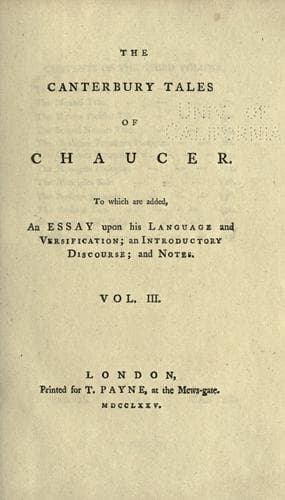
The Canterbury Tales, and Other PoemsChaucer, Geoffrey
ReligionChristian
The Canterbury Tales, and Other Poems
Chaucer, Geoffrey
Chaucer, Geoffrey, -1400; Christian pilgrims and pilgrimages -- Poetry; English poetry -- Middle English, 1100-1500
“Ye be my lord, do with your owen thing
Right as you list, and ask no rede of me:
For, as I left at home all my clothing
When I came first to you, right so,” quoth she,
“Left I my will and all my liberty,
And took your clothing: wherefore I you pray,
Do your pleasance, I will your lust* obey. *will
“And, certes, if I hadde prescience
Your will to know, ere ye your lust* me told, *will
I would it do withoute negligence:
But, now I know your lust, and what ye wo’ld,
All your pleasance firm and stable I hold;
For, wist I that my death might do you ease,
Right gladly would I dien you to please.
“Death may not make no comparisoun
Unto your love.” And when this marquis say* *saw
The constance of his wife, he cast adown
His eyen two, and wonder’d how she may
In patience suffer all this array;
And forth he went with dreary countenance;
But to his heart it was full great pleasance.
This ugly sergeant, in the same wise
That he her daughter caught, right so hath he
(Or worse, if men can any worse devise,)
Y-hent* her son, that full was of beauty: *seized
And ever-in-one* so patient was she, *unvaryingly
That she no cheere made of heaviness,
But kiss’d her son, and after gan him bless.
Save this she prayed him, if that he might,
Her little son he would in earthe grave,* *bury
His tender limbes, delicate to sight,
From fowles and from beastes for to save.
But she none answer of him mighte have;
He went his way, as him nothing ne raught,* *cared
But to Bologna tenderly it brought.
The marquis wonder’d ever longer more
Upon her patience; and, if that he
Not hadde soothly knowen therebefore
That perfectly her children loved she,
He would have ween’d* that of some subtilty, *thought
And of malice, or for cruel corage,* *disposition
She hadde suffer’d this with sad* visage. *steadfast, unmoved
But well he knew, that, next himself, certain
She lov’d her children best in every wise.
But now of women would I aske fain,
If these assayes mighte not suffice?
What could a sturdy* husband more devise *stern
To prove her wifehood and her steadfastness,
And he continuing ev’r in sturdiness?
But there be folk of such condition,
That, when they have a certain purpose take,
Thiey cannot stint* of their intention, *cease
But, right as they were bound unto a stake,
They will not of their firste purpose slake:* *slacken, abate
Right so this marquis fully hath purpos’d
To tempt his wife, as he was first dispos’d.
Public-domain text, read in full here on John Shaqi.
Reviews
Reviews
No reviews yet
Be the first to share your thoughts on this work.
Elsewhere in the archive
Join the Discussion
Join the discussion
Sign in to leave a comment or review.
Sign InorCreate an account