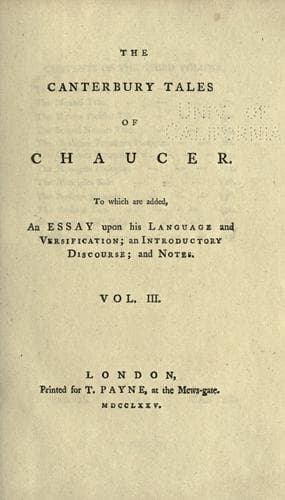
The Canterbury Tales, and Other PoemsChaucer, Geoffrey
ReligionChristian
The Canterbury Tales, and Other Poems
Chaucer, Geoffrey
Chaucer, Geoffrey, -1400; Christian pilgrims and pilgrimages -- Poetry; English poetry -- Middle English, 1100-1500
“O tender, O dear, O young children mine,
Your woeful mother *weened steadfastly* *believed firmly*
That cruel houndes, or some foul vermine,
Had eaten you; but God of his mercy,
And your benigne father tenderly
Have *done you keep:”* and in that same stound* *caused you to
All suddenly she swapt** down to the ground. be preserved*
*hour **fell
And in her swoon so sadly* holdeth she *firmly
Her children two, when she gan them embrace,
That with great sleight* and great difficulty *art
The children from her arm they can arace,* *pull away
O! many a tear on many a piteous face
Down ran of them that stoode her beside,
Unneth’* aboute her might they abide. *scarcely
Walter her gladdeth, and her sorrow slaketh:* *assuages
She riseth up abashed* from her trance, *astonished
And every wight her joy and feaste maketh,
Till she hath caught again her countenance.
Walter her doth so faithfully pleasance,
That it was dainty for to see the cheer
Betwixt them two, since they be met in fere.* *together
The ladies, when that they their time sey,* *saw
Have taken her, and into chamber gone,
And stripped her out of her rude array,
And in a cloth of gold that brightly shone,
And with a crown of many a riche stone
Upon her head, they into hall her brought:
And there she was honoured as her ought.
Thus had this piteous day a blissful end;
For every man and woman did his might
This day in mirth and revel to dispend,
Till on the welkin* shone the starres bright: *firmament
For more solemn in every mannes sight
This feaste was, and greater of costage,* *expense
Than was the revel of her marriage.
Full many a year in high prosperity
Lived these two in concord and in rest;
And richely his daughter married he
Unto a lord, one of the worthiest
Of all Itale; and then in peace and rest
His wife’s father in his court he kept,
Till that the soul out of his body crept.
His son succeeded in his heritage,
In rest and peace, after his father’s day:
And fortunate was eke in marriage,
All* he put not his wife in great assay: *although
This world is not so strong, it *is no nay,* *not to be denied*
As it hath been in olde times yore;
And hearken what this author saith, therefore;
This story is said, <14> not for that wives should
Follow Griselda in humility,
For it were importable* though they would; *not to be borne
But for that every wight in his degree
Shoulde be constant in adversity,
As was Griselda; therefore Petrarch writeth
This story, which with high style he inditeth.
Public-domain text, read in full here on John Shaqi.
Reviews
Reviews
No reviews yet
Be the first to share your thoughts on this work.
Elsewhere in the archive
Join the Discussion
Join the discussion
Sign in to leave a comment or review.
Sign InorCreate an account