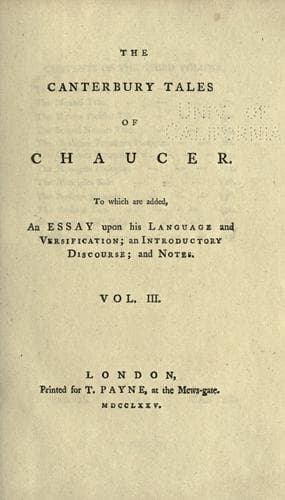
The Canterbury Tales, and Other PoemsChaucer, Geoffrey
ReligionChristian
The Canterbury Tales, and Other Poems
Chaucer, Geoffrey
Chaucer, Geoffrey, -1400; Christian pilgrims and pilgrimages -- Poetry; English poetry -- Middle English, 1100-1500
“If thou be fair, where folk be in presence
Shew thou thy visage and thine apparail:
If thou be foul, be free of thy dispence;
To get thee friendes aye do thy travail:
Be aye of cheer as light as leaf on lind,* *linden, lime-tree
And let him care, and weep, and wring, and wail.”
Notes to the Clerk’s Tale
1. Petrarch, in his Latin romance, “De obedientia et fide uxoria
Mythologia,” (Of obedient and faithful wives in Mythology)
translated the charming story of “the patient Grizel” from the
Italian of Bocaccio’s “Decameron;” and Chaucer has closely
followed Petrarch’s translation, made in 1373, the year before
that in which he died. The fact that the embassy to Genoa, on
which Chaucer was sent, took place in 1372-73, has lent
countenance to the opinion that the English poet did actually
visit the Italian bard at Padua, and hear the story from his own
lips. This, however, is only a probability; for it is a moot point
whether the two poets ever met.
2. Vesulus: Monte Viso, a lofty peak at the junction of the
Maritime and Cottian Alps; from two springs on its east side
rises the Po.
3. Buxomly: obediently; Anglo-Saxon, “bogsom,” old English,
“boughsome,” that can be easily bent or bowed; German,
“biegsam,” pliant, obedient.
4. Well ofter of the well than of the tun she drank: she drank
water much more often than wine.
5. Undern: afternoon, evening, though by some “undern”
is understood as dinner-time — 9 a. m. See note 4 to the Wife of
Bath’s Tale.
6. Very: true; French “vrai”.
7. Nouches: Ornaments of some kind not precisely known;
some editions read “ouches,” studs, brooches. (Transcriber’s
note: The OED gives “nouches” as a form of “ouches,”
buckles)
8. A furlong way or two: a short time; literally, as long as it
takes to walk one or two furlongs (a furlong is 220 yards)
9. Lordes’ hestes may not be y-feign’d: it will not do merely to
feign compliance with a lord’s commands.
10. Arace: tear; French, “arracher.”
11. Fele: many; German, “viel.”
12. Dear enough a jane: worth nothing. A jane was a small coin
of little worth, so the meaning is “not worth a red cent”.
13. Mo: me. “This is one of the most licentious corruptions of
orthography,” says Tyrwhitt, “that I remember to have observed
in Chaucer;” but such liberties were common among the
European poets of his time, when there was an extreme lack of
certainty in orthography.
14. The fourteen lines that follow are translated almost literally
from Petrarch’s Latin.
15. For great skill is he proved that he wrought: for it is most
reasonable that He should prove or test that which he made.
16. Chichevache, in old popular fable, was a monster that fed
only on good women, and was always very thin from scarcity of
such food; a corresponding monster, Bycorne, fed only on
obedient and kind husbands, and was always fat. The origin of
the fable was French; but Lydgate has a ballad on the subject.
“Chichevache” literally means “niggardly” or “greedy cow.”
Public-domain text, read in full here on John Shaqi.
Reviews
Reviews
No reviews yet
Be the first to share your thoughts on this work.
Elsewhere in the archive
Join the Discussion
Join the discussion
Sign in to leave a comment or review.
Sign InorCreate an account