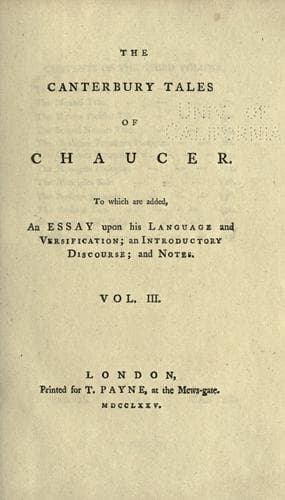
The Canterbury Tales, and Other PoemsChaucer, Geoffrey
ReligionChristian
The Canterbury Tales, and Other Poems
Chaucer, Geoffrey
Chaucer, Geoffrey, -1400; Christian pilgrims and pilgrimages -- Poetry; English poetry -- Middle English, 1100-1500
He rubbed her upon her tender face,
And saide thus; “Alas! I must trespace
To you, my spouse, and you greatly offend,
Ere time come that I will down descend.
But natheless consider this,” quoth he,
“There is no workman, whatsoe’er he be,
That may both worke well and hastily:
This will be done at leisure perfectly.
It is *no force* how longe that we play; *no matter*
In true wedlock coupled be we tway;
And blessed be the yoke that we be in,
For in our actes may there be no sin.
A man may do no sinne with his wife,
Nor hurt himselfe with his owen knife;
For we have leave to play us by the law.”
Thus labour’d he, till that the day gan daw,
And then he took a sop in fine clarre,
And upright in his bedde then sat he.
And after that he sang full loud and clear,
And kiss’d his wife, and made wanton cheer.
He was all coltish, full of ragerie * *wantonness
And full of jargon as a flecked pie.<16>
The slacke skin about his necke shaked,
While that he sang, so chanted he and craked.* *quavered
But God wot what that May thought in her heart,
When she him saw up sitting in his shirt
In his night-cap, and with his necke lean:
She praised not his playing worth a bean.
Then said he thus; “My reste will I take
Now day is come, I may no longer wake;
And down he laid his head and slept till prime.
And afterward, when that he saw his time,
Up rose January, but freshe May
Helde her chamber till the fourthe day,
As usage is of wives for the best.
For every labour some time must have rest,
Or elles longe may he not endure;
This is to say, no life of creature,
Be it of fish, or bird, or beast, or man.
Now will I speak of woeful Damian,
That languisheth for love, as ye shall hear;
Therefore I speak to him in this manneare.
I say. “O silly Damian, alas!
Answer to this demand, as in this case,
How shalt thou to thy lady, freshe May,
Telle thy woe? She will alway say nay;
Eke if thou speak, she will thy woe bewray; * *betray
God be thine help, I can no better say.
This sicke Damian in Venus’ fire
So burned that he died for desire;
For which he put his life *in aventure,* *at risk*
No longer might he in this wise endure;
But privily a penner* gan he borrow, *writing-case
And in a letter wrote he all his sorrow,
In manner of a complaint or a lay,
Unto his faire freshe lady May.
And in a purse of silk, hung on his shirt,
He hath it put, and laid it at his heart.
Public-domain text, read in full here on John Shaqi.
Reviews
Reviews
No reviews yet
Be the first to share your thoughts on this work.
Elsewhere in the archive
Join the Discussion
Join the discussion
Sign in to leave a comment or review.
Sign InorCreate an account